Showing posts with label CoL. Show all posts

Wednesday, 8 October 2025

CoL Inquiry 2025 - Part Six

In order to gain quantitative data I constructed a customised eAsttle test for my inquiry group to take. It would assess Number Knowledge, Number Strategy, and Algebra. The results, while they don't indicate a massive shift in overall progress are incredibly affirming. They confirm that my previous focus on improving comprehension of whole number and single-step problems was the correct priority.


This has established a strong foundation: The group demonstrated 100% success in procedural objectives like "Model and solve linear, simultaneous & simple quadratic equations." They also performed strongly in finding and expressing rules for number sequences. When the language is direct and tells them what to do (solve, model, find a rule), they now execute confidently.

This is a significant positive step. Our work has clearly improved their ability to translate straightforward narrative into the correct mathematical procedures, which is critical for problem solving.

 The beauty of these results is how they align perfectly with the current curriculum map. The most significant gaps revealed by the test are in topics we simply haven't covered yet in our Pr1me program. I don't look at it as a failure in my current teaching; it's a powerful
alert about where I need to proactively prepare the students' language skills.

The biggest gaps (within the focus areas) sit in the three major concepts that Pr1me will introduce later this year:

  • Negative Numbers: The largest gap is "Explain the meaning of negative numbers" (69% Gaps).
  • Decimals: There's a 50% Gaps rate in "Write & solve whole number/decimal problems using all four operations."
  • Fractions: Students struggled with "Write/solve story problems involving basic fractions" (25% Gaps).

The data tells me that when Pr1me introduces these units, the content itself will be the secondary problem; the primary barrier will still be the complex language because it's more abstract and intricate than the whole number problems they've mastered. They need to understand the words before they can do the math.

The comparison of the earlier diagnostic tests to our recent e-asTTle results has been the most powerful validation of my inquiry cycle yet. The data confirms what I hoped: the strategic focus on comprehension and whole-number strategy has successfully closed old gaps, providing a strong foundation for the Pr1me program.


Here is a quick look at where each student has shifted in their Number Knowledge and Strategy since the start of the year, followed by an analysis of the group's overall progress.


Individual Progress Snapshot: Closing Gaps

Student (Current Level) Key Improvement Area (Strategy/Comprehension) Remaining Challenge (New Barrier)

Student A (3P) Clear Word Problem Gain: They've overcome the language barriers they had in simple multiplication and division word problems. They are now successfully translating simple narratives. Large Number Language: The comprehension barrier remains for place value in large whole numbers and the conceptual language of fractions.

Student B (2A) Procedural Clarity: Johan gained competence in the language of order of operations and is successfully translating simple word problems. They've overcome their earlier struggles with visual strategies like number lines. Foundational Facts & Fractions: They're still struggling with basic addition/subtraction facts and the complex translational language required by fractions.

Student C (3B) Procedural/Algebraic Language: They shows strong gains in understanding the language of order of operations and the procedural concepts of powers of whole numbers. Fractional and Conceptual Language: The language of simple fractions is still a consistent barrier, as is the abstract definition of negative numbers.

Student D (3B) Place Value Mastery: They've successfully overcame their early struggles with interpreting the language of place value and is now applying that understanding to decimals. Translational Fraction Barrier: Their most consistent weakness is the inability to translate a word problem that includes a fractional quantity into an equation.

Student F (3P) Fractional Head Start: They are unique—they've showed success in the initial stages of fraction word problem translation, an area of difficulty for the rest of the group. They've made strong gains in procedural language. Algebraic Patterns: Their remaining weakness is translating the language of patterns and sequential rules, suggesting a distinct type of abstract language comprehension issue.

Student G (3B) Strategy/Procedural Gain: They've successfully transitioned from struggling with simple division word problems to mastering order of operations. Their highest score in Algebra shows excellent procedural command. Fragile Conceptual Language: Their understanding of negative numbers is fragile, indicating that the language used to define and apply the concept needs dedicated reinforcement.

Student H (3B) Strong Strategy Gains: They've moved from struggling with simple division to mastering multi-step problem combinations. This is the clearest example of a direct win for my inquiry on comprehension and translation. Advanced Algebraic Comprehension: Their struggles with the language required to use a rule to make predictions and describe patterns in sequence.

The comparison of the earlier PAT test results from the start of the year provides strong evidence that my inquiry cycle focusing on comprehension and whole-number strategy has been effective. We've successfully built the necessary language bridge.

1. Number Knowledge Progress: Success in Foundational Language

Positive Shift : Nearly all students have significantly improved their ability to read and interpret the language of place value in whole numbers and are now successfully applying that foundational language to decimal place value. This is a big leap from the initial struggles we saw at the start of the year.

2. Strategy (Number Sense & Operations) Progress: Mastery of Simple Translation

Positive Shift : Every single student who initially struggled with single-step, whole-number word problems is now scoring highly or achieving in "Write & solve whole number story problems." The most significant result is their successful transition to solving problems with combinations of operations. The language decoding for simple arithmetic is now working.

Next Barrier : The strategy breakdown occurs when students must translate a multi-step word problem that also contains complex number language (fractions, decimals). The inability to "Solve problems using fractions of whole numbers or decimals" is the new strategic weakness, showing that the strategy itself needs a more advanced layer of comprehension.

The work we've done has provided the necessary language bridge to move from non-comprehension to solid procedural understanding in foundational arithmetic. My next step—pre-teaching the language of upcoming complex units (fractions, decimals, negatives) before the Pr1me program introduces them—is perfectly validated by where their progress is currently stalling. My inquiry remains focused on comprehension, but it must now shift from addressing prior gaps to proactive preparation for upcoming units.

A revitalised look at my inquiry focus is: How can I use explicit literacy strategies to pre-teach the conceptual and translational vocabulary of concepts? I will be tracking my target group as I learn to better support them, not by teaching ahead of the Pr1me program, but by teaching the language of the concepts ahead of it. The goal is to improve their literacy toolkit so they can tackle new concepts with greater confidence.

The journey continues, and the data confirms I am focused on the right path for supporting my students' mathematical language development.

Tuesday, 24 June 2025

CoL 2025 - Part Three

This year, we've been working hard to implement a more structured approach to maths using the PR1ME Maths program, which I’ve found incredibly helpful for building strong number sense and step-by-step thinking in students. Each lesson scaffolds understanding clearly—Understand the Problem, Plan what to do, Work out the Answer—and students respond well to the predictable structure.

But I started to notice something. Despite the structure, many students were still getting stuck on multi-step problems, especially when the wording got tricky. Even with a model or clear number strategy, some students weren’t quite sure what was actually happening in the problem.


That’s when I decided to trial the 3 Reads Protocol alongside PR1ME. 

What is the 3 Reads Protocol?

It’s a comprehension strategy borrowed from literacy and adapted for maths word problems.

1.  What is the problem about?

(Just the context—no numbers yet. Are we talking about muffins? Trains? People?)

2.  What is the problem asking?

(Focus on the question. What are we meant to find out?)

3.  What are the important numbers or facts?

(What do we need to solve the problem? Which strategy might work?)


How Does This Compare to PR1ME’s Approach?

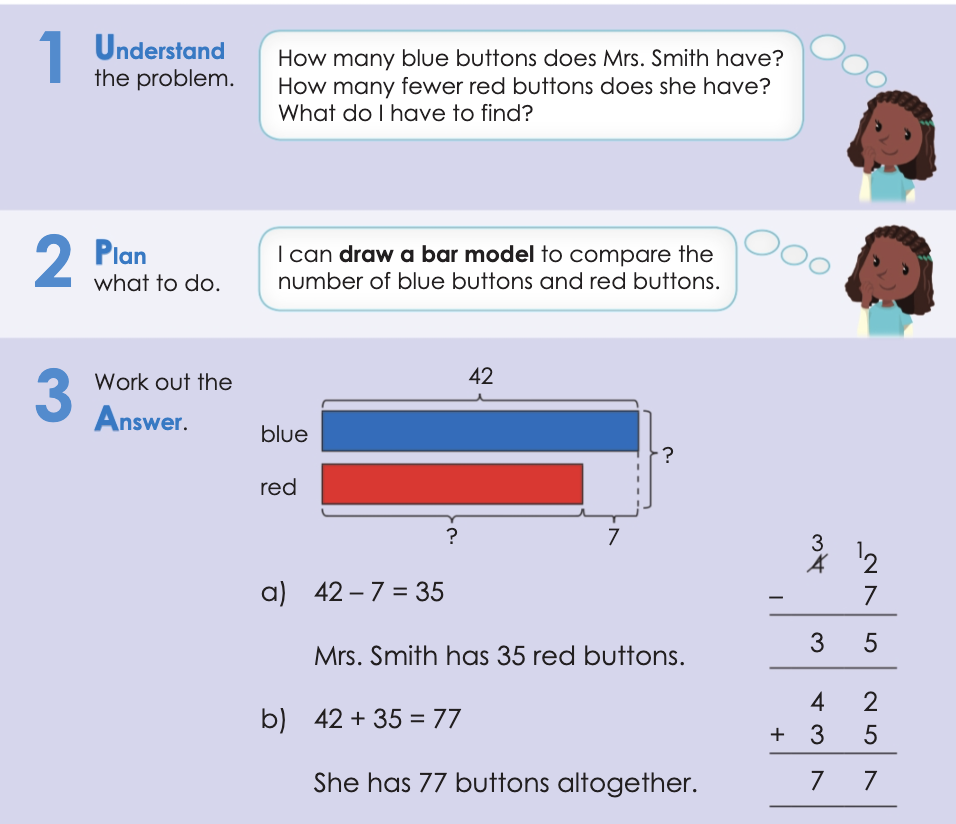
The PR1ME problem-solving routine (like the image above) follows a similar flow:


1. Understand the Problem; Students are prompted to ask questions:

How many blue buttons? How many fewer red? What do I need to find?

2. Plan what to do; They draw a bar model, or visualise with a known strategy.

3. Work out the answer They solve, step-by-step.

There are a number of similarities in each of the protocols:

- Encourage thinking before solving

- Focus on the story behind the numbers

- Encourage visual strategies like drawing or bar models

- Build mathematical language through questioning


But here’s the key difference:

👉 The 3 Reads Protocol slows down the reading comprehension process even more.

It makes students treat the problem like a piece of reading rather than just a maths equation hiding in a story. Strategies which can then be applied are to use manipulatives, or visualisation strategies like bar models that can help students turn a confusing question into a problem they can understand and solve without needing as much reading comprehension.


In practice:

In large group/class instruction, I stuck to the PR1ME structure, as it aligns with the scope and expectations of our program. The vocabulary and worked examples help all students—especially those who thrive with repetition and visual modelling.

We’ll continue using both. The PR1ME problem-solving routine is here to stay—it’s well-structured, scaffolded, and clearly links to our curriculum refresh.

But I see real value in making room for the 3 Reads Protocol in:

- Small group problem-solving

- Mixed-ability collaborative tasks

- Problem-solving challenges or rich tasks

In short:

We’re not replacing one with the other. We’re building a toolkit—and giving students more ways to understand, approach, and solve.

I am excited to see the results of this; we have had a very staggered end of term, but moving into the next term we will administer a Chapter Test which will require students to solve word problems; am unsure how well they will be able to independently apply the protocol. We will continue to build on this in Term 3.

If you’re noticing students can’t make sense of the maths problem even though they know the strategy, try the 3 Reads approach. Sometimes the barrier isn’t the maths—it’s the language.

Wednesday, 19 February 2025

CoL 2025 - Part One

This is my third year reflecting on this very same question; How can I support my lower literacy students with their comprehension of word problems in maths?

Last year I thought I'd worked out an effective solution; use the CPA approach to strengthen their foundational and conceptual understanding, however there was a limitation in this. Most frequently the A in CPA was symbolic, it was using digits, numbers, and operational symbols. It did not address the hole in their understanding that was decoding, and comprehending what the word problems they faced were asking of them. 

THE CPA APPROACH | Smartli | Singapore Math 

For the first time since I began teaching I have struggled to find a focus for my inquiry; not because I haven't identified areas in my student's learning that needs further support, but because for the first time in my own career I am teaching to a structured program.

This year, like all of you, I have been tasked with rolling out a structured Maths program, in our case Scholastic's Pr1me Mathematics, and boy has it been a learning curve. 

PR1ME Mathematics | Scholastic ...

First, let me start by saying I am thoroughly enjoying the program so far; as someone who can be very pedantic about the resources I use in my class I have spent countless hours trying to create learning experiences that are engaging, interesting, and enjoyable for my students to use. Pr1me has done an incredible job of taking that job off my hands.

However, it is through the using of resources not produced by me that I encountered the first obstacle for my students. The first part of the Pr1me program is a diagnostic test. This test is used to determine which Book of the program the students will take on for they year. For our students this was a gruelling experience. 14 pages, back and front. Writing with pencils, instead of their mouse. Questions with a wide variety of difficulties, some straightforward, some multi-step problem solving. This was definitely not something our students were used to. The results of the test spoke for themselves; most students answered between 5-10 of the 30+ questions in the test with some accuracy, or indication of strategic thinking.

After they finished the test, we did a little bit of a debrief; 

How did you find the test? What was the hardest part about it? What did you find most confusing?

There were a wide range of answers, however the fundamental theme throughout them was a lack of understanding around what the question was actually asking them to do. 

I rewrote 3 questions on the board, mimicking the style of questions they had just done in the test. We went through it together, drawing out the key numbers, and finding the operative words in the question. With plenty of support and guidance we ended up turning the word problem into a numerical equation, that the students were able to very easily solve using strategies they had been learning with me.

So where's the barrier; what is it that they are not understanding? It has to be the words. It just has to.

So; here our journey begins. I'm narrowing down my target group, but I am going to look at the students in my class with lower level literacy, and low level of maths, and tracking their progress, as I learn to better support them, now with the structure, (or restrictions) of the Pr1me program.

Follow along to see where how far we'll go!


Wednesday, 16 October 2024

CoL Inquiry - Using Evidence to Guide Practice - Part Five

My math practice this year has made considerable changes; personally I like I've grown in confidence with my practice, the research, the conversations (with colleagues and students), reflections, and all of it has left me feeling more capable as a teacher, and it has translated into students who feel much more confident and are enjoying math. One of the pieces of qualitative data I gathered at the start of my inquiry was their voice; how were they feeling about maths; here's what they said.

I will be reissuing this same questionnaire this week, and I am super excited to see the results; in speaking with my students they are feeling more capable, and demonstrate this on a regular basis in class.

In terms of data the previous blog post has what we have done so far, eAsttle test provided me next steps, and Gloss testing is being done - as I write this I am nearly finished with my inquiry group, and even without another Gloss Test from the start of the year (reminding myself how good they are, and that I need to do more of them)  I can feel their conceptual understanding has improved. In terms of quantitative results, I have now tested 6 of the students in my inquiry group. Each of them has reached Stage 6 in Addition/Subtraction, most, if not all have reached Stage 5+ in Multiplication and division. 


This still means they are working towards achieving at the level that they should be, however, they have all shifted upwards; their OTJs had them placed at Year 4, some early, some late, but definitely below the expected level. A single test is not indicative of their progress, but I can't help but be excited to see this acceleration.

Wednesday, 29 May 2024

CoL - Part Three (CPA Approach)

 Teaching Maths was the thing I was most intimidated by when I made the move to primary teaching. I am an English major, and trained as a teacher of English. My learning journey with math was an interesting one. I did well when I was at in primary; I was good at following the "algorithms". I was lucky enough to live in and attend school in Chile, and was learning long division by 8 years old, but I think algebra was where the problems started. Dealing with unknown variables, and identifying patterns by applying formulas was very confusing. "What happened to 8 + 9 is 17, carry the one...?!" . It seemed that everyone who did well was in on a secret that I wasn't privy to. Their brains were able to unlock the mysteries of maths, and I felt like I was locked out.

I made a promise to myself, that I was going to do what I could to ensure that no student in my class was going to feel as lost, and confused as I was. I didn't know how best to do that, and 4 years after becoming a primary teacher I am still figuring it out, however. I think I have found something that has changed my view on maths, and I hope can help my own students to learn maths by giving them the keys that will help them unlock the "mysteries" of maths.

I found myself trying to read as much as I could about conceptual understandings; I felt like if my students could build a strong conceptual understanding in my next unit, that it would allow them to apply sttrategies to a wider range of problems, including word or picture problems which require inference, and comprehension on top of mathematical problem solving.

Identifying what my students problem is has been a multi-fold approach; I've looked at their results in PAT Maths, Gloss, and through my observations in class. My original hypothesis was focused around the fact that they needed support with their vocabulary, and that that was a major limiting factor in their ability to solve problems, like the ones in PAT tests, and activities in the Caxton textbooks. What I have observed and noticed is that a lot of them do not have much confidence with the overall concepts. If the question is easy to understand, even if the mathematical operation is challenging, they can apply their strategies to it. 

What I would like to do know is to continue supporting their vocabulary, but also to improve their confidence and self efficacy when it comes to solving the wide variety of problem types that they will encounter. 

The CPA approach was one that resonated with me early on; developed by psychologist Jerome Bruner it's focus is on building conceptual understanding of maths by working through stages; concrete, pictorial, and abstract.


The Concrete element involves the use of materials; for my students this was particularly instrumental in helping them develop their conceptual understanding of multiplication and division. Being able to move blocks, or beans, or money around, and physically manipulate these objects meant that strategies like grouping, repeated addition, or subtraction had practical meaning. I think this approach was the most pivotal, as I could see them responding, and understanding. Those "ah ha!" moments that we cherish so much as teachers were really evident in this stage.

We then moved on to the Pictorial stage, in which students could see visual representations of the problems; this worked really well with arrays, and grouping as well because they could see the objects they were being asked to apply their strategies to. 

The Abstract stage being the final stage of the approach is one that really threw me for a loop the first time I read about it; I grew up doing maths with symbols from a very early age, and it hadn't clicked to me that these symbols and digits were abstract representations. Once I started to think more carefully about when I gave my students these abstract questions it became apparent that my sequencing had been askew.

The other aspect to this was based on an interesting article that was shared with me from a couple of different people, and obviously it resonated with them, so I delved into it. The original article was an Op-Ed published by the University of Auckland, titled "What maths teaching could and should learn from cognitive science" - it spoke on the fact that these "exploration" type of maths lessons showed no discernible benefit to student's learning. Following up was the article that was referenced in the Op-Ed which was a paper titled "Why Minimal Guidance during Instruction Does Not Work: an Analysis of the Failure of Constructivist, Discovery, Problem-Based, Experiential, and Inquiry-Based Teaching".

This was again, pretty eye opening; it spoke about the fact that simply allowing students to explore concepts with little or no scaffolding or support in the form of explicit teaching, meant essentially that we were relying on students to learn simply by exposure or osmosis. There needed to be concrete, explicit teaching of these concepts if they were going to be able to learn, retain, and apply them to the wide range of problems they will be faced with.

We have recently come to the end of a 5 week unit, beginning with multiplication, moving on to division, and then to applying strategies, and will be conducting an eAsttle test on them in the next week, I'm excited to see if the results reflect the progress they have made in group work; knowing they can do it with me, it's time to see if they can apply these concepts with the training wheels off, so to speak. 

I'll see you guys in the next instalment!


References:

Bourtzinakou, E. (2023). Developing Mathematical Reasoning; The role of the CPA model in students’ progress from standard to Reasoning and Problem-Solving questions. https://www.et-foundation.co.uk/wp-content/uploads/2023/02/The-role-of-a-CPA-model-in-developing-mathematical-reasoning_Gateshead-College-CfEM-action-research-report-2021-22_compressed.pdf

Kirschner, P. A., Sweller, J., & Clark, R. E. (2006). Why Minimal Guidance during Instruction Does Not Work: an Analysis of the Failure of Constructivist, Discovery, Problem-Based, Experiential, and Inquiry-Based Teaching. Educational Psychologist, 41(2), 75–86. https://doi.org/10.1207/s15326985ep4102_1

Main, P. (2021). Concrete pictorial abstract approaches in the classroom. www.structural-learning.com. https://www.structural-learning.com/post/concrete-pictorial-abstract-approaches-in-the-classroom

N.A What maths teaching could and should learn from cognitive science - The University of Auckland. (n.d.). Www.auckland.ac.nz. https://www.auckland.ac.nz/en/news/2024/04/10/What-maths-teaching-could-should-learn-from-cognitive-science.html


A Brand New Voyage!

  I start, and finish every year off with such a great sense of excitement; Christmas, New Years, and long, merry days in the sun wondering ...