Showing posts with label MIT2023. Show all posts

Sunday, 19 November 2023

MIT 2023 - The End of the Journey

As my father always told me  "All good things must come to an end", and this MIT journey for 2023 has finally come to an end. It is a bittersweet goodbye. I walk away from this project with a tremendous sense of pride in what we have accomplished together. MIT 2023 has been one of the most significant highlights of my year and has opened up so many opportunities, discussions, conversations, reflections, and friendships that have improved my practice and my outlook on teaching; the value of the MIT project goes far beyond the tools we have created, it is an opportunity to take part in a community of learning that is equal parts fun, inspiring, and motivating.

MathVentures is just the beginning; starting my investigation into math vocabulary has inspired my next inquiry cycle; investigating how we can continue to help our students comprehend the word problems they encounter in maths, and how we can support our students to build a robust math vocabulary that will help them to better understand how maths is applied in more real-world contexts.

Check out MathVentures here!


 In a way, the end of this journey opens up a door to a whole new set of opportunities to learn and develop my practice, and in turn, improve the outcomes for my akonga. As lifelong learners I think it is so critical for us to continue to pursue these avenues as they open up to us, and while MIT has come to an end this year, it is the start of a whole new journey.

I would like to first acknowledge my fellow MIT alumni for 2023; Crystal, Michelle, Essie, Jayne, and Maiken. You guys have been a blessing to work on this project with. Without the support and encouragement from you guys, I don't know if my project would have reached the stages that it is at now. Thank you so, so much. I am so lucky to have been a part of such a cool crew, and I won't forget our adventures any time soon! That boat trip to Russell is easily one of my favourite memories. 


Secondly, I would like to acknowledge the tremendous work put in by Matt Goodwin, Dorothy Burt, Justine Todd, and Jenny Oxley; the knowledge, experience, and feedback they have given us along our journey have been invaluable, and their contributions to our projects cannot be understated.

I cannot recommend this program highly enough, if you are thinking of applying, please do. You will gain invaluable insights, relationships, and confidence in your own practice that is hard to come by elsewhere.

Kia ora rawa atu,
Gabe


Sunday, 15 October 2023

MIT 2023 - Bay of Islands Summit

What an experience! Sorry, this could be a long post.

As part of our journey for MIT23 we are lucky enough to be presenters at the Bay of Island's Teacher's Summit 2023. This summit was an incredible opportunity for so many reasons; meeting new people, discussing interesting ideas, and learning new skills, and tools that we can take home for our akonga. 

The journey up began bright and early on the first Saturday of the school holidays. Forgoing the usual bliss of the first sleep-in of the holidays, I gathered my bags and was dropped off at school. I load the school van and pick up my trusted travel companion, Mr Goodwin on the way. The weather on the way out of Auckland had me dreaming about the "Winterless North". Rain poured for hour after hour, when finally we reach Kawakawa, less than half an hour from our destination, and more than an hour ahead of our airport run. We were feeling good. With our satnav turned off, and arrogance coursing through our veins we follow the path through Kawakawa, and head north over the "up downs" (iykyk). 

After another hour of driving we become suspicious that something had gone awry. "Surely we should be there by now. Surely we can't have missed the signs." Ahh, yeah. We had. I'm not sure how familiar you are, reader, of New Zealand geography, but let me give you a fun fact. Oponone (where we were) and Paihia (where we should have been) are on opposite coasts. Feeling about as dumb as it's possible to feel, we reluctantly turned on the satnav to inspect the situation. Maps said we should be okay, we continue this road, hang a right, 9km of bush road, and we'll be right back to where we should be. I'm still thankful to whoever decided, as we made our way through hairpin turns, and narrowing unpaved roads, to turn the rain off. The only dry part of our drive was through the bush, and by golly, that was lucky. 

What was even luckier was that after the slight detour, we arrived at the Kerikeri Airport just as my fellow MIT colleagues walked out of the airport, none the wiser that they might have been stuck there had we not made it out of the bush.

On our way to the accommodation we catch up; it's been such a lovely experience working alongside these teachers. They are creative, passionate, and as the title of our program would suggest, innovative, and I'm so lucky to have worked alongside them this year. We remark that this will all soon come to an end and that we're going to have to make sure we keep in touch after this is all said and done. 

We're up bright and early for our first day of the Summit. The day begins with a beautiful powhiri, and a korero from the respective rangatahi. The keynote speaker for the event was the principal of our gracious host school, Bay of Islands College, Mrs Edith Painting. 

The first day was comprised of several wonderful workshops, a beautiful kai for lunch, and an awesome cultural experience. I chose to visit the Waitangi Treaty Grounds; I hadn't been since a teen, and my knowledge and understanding of Te Tiriti had definitely increased my hunger to learn more about such a significant place in Aotearoa New Zealand history. 


Day two was our turn. We were the first presenters, and unlike the other presenters, who were only presenting to a classroom full of teachers, we presented in the hall in front of all of them. I'm sure many of you will empathise; the classroom is our safe space, and where we feel most comfortable speaking publicly. Speaking in a hall, at an assembly, or at a summit, that's another kettle of fish. 

One of the best parts of this program is that we never have to do anything on our own. The support and encouragement that we give to each other was such a strong help, and I don't know if I would have been able to do the same on my own. 

I'll leave you with a couple of links to explore if you'd like to see more of our adventure! It was honestly such a blast, and an experience that I will not forget.

Bay of Island's Summit


Tuesday, 18 July 2023

MIT 2023 - Site went live!

In the last block today the site went live, and I introduced it to Rooms 6,7,8 (all Year 6 classes) - there were some teething issues that arose like I needed to make sure that the site was not editable by everybody with the link - the students discovered this pretty quickly and a couple of them played around with the layout, so after a quick restore, and making sure all the new links were in place we started. A lot of the children chose to go for the easy MathVenture to start with, which I was not fussed about, I would like to see more of them go for the challenging texts, however, the tool is designed for self-selection, and students can progress through the difficulties at their own pace. 

One of the other issues that arose, that I was not able to diagnose on the spot was that some of the students found themselves unable to scroll down the page, while others were able to. I will have to figure out what was causing this issue and address it. 


The feedback from the students was overwhelmingly positive - they were excited to have more texts to take on, and I think what I will need is to find a time to regularly put out new ones - am thinking perhaps weekly, or fortnightly as I don’t want to over-promise and under deliver. I had a discussion with my team leader, who works with our lower-level literacy students, about the texts being more level-appropriate; she would like for the texts to be more readable, and perhaps shorter in length for the students at lower reading levels - we have students in our space who have reading ages of around 5-6 years of age, and even the easy texts were too long, and perhaps too difficult for them to make sense of and enjoy.


I will focus on the enjoyment element of it, as this is supposed to be engaging, and not a literacy-focused task - it is about unpacking the vocabulary. She also suggested that instead of having different word hyperlinks lead to the same page, and designed so that each hyperlink has a dedicated page of its own, for example, the “half” hyperlink leads to the same clarification as “share” rather than to a clarification of its own. She thought this would be a little confusing, I agree, however, I would also like for them to be able to see what other words can mean the same thing. Another comment was about having more images, and visual representation of the concepts to account for different learning styles. This will be time-consuming to set up, however, I can see real value in perhaps setting up separate clarification slides for each of the different difficulties, as the students taking on the easier challenges, and the students taking on the most difficult challenges are being linked to the same clarifications, some of which contain a great deal of writing on them. I still would like to limit each clarification to one slide per concept, as having to navigate through separate slides to find information can cause distractions and confusion, and take away from their flow as they move through the MathVenture. We have our MIT Online meets today, so perhaps I can use that to help with all of this.

Saturday, 27 May 2023

MIT 2023 - KPMG Hui #2


Another early morning start, I tried asking my partner for a ride into the city to save myself a couple bucks, but her unintelligible groans gave me a pretty clear indication that I should find my own way in. 


I arrive early, and myself and Matt tap away on our laptops until the rest of the crew arrived. I think we'd both had a rough week of Fantasy so thought it best to leave that subject alone, and we trot over to the KPMG offices. A massive thank you, as always to Justine for hosting us so wonderfully, but for her helpful input, and advice. We begin our day reflecting on our project so far in the WWW session. This is such a great crew, and looking at their work, I am blown away at their creativity, and the innovative ideas they've come up with. I can't wait to see where we all end up. Sharing ideas in a setting like this has now become such an awesome experience, I feel privileged to be able to share ideas, and have them help me to craft and hone my own.


We presented our prototype testing - I was nervous for my testing, there were a lot of moving parts in my prototype design, from audio clips on Youtube, to response validations, with multiple questions, and large chunks of my own narrative writing (don't get me started on how nervous that part makes me) for my students to give me feedback on.  The testing started with a flop. My Youtube videos had not been properly categorized, and were unable to be viewed on our student's devices. Once that was sorted the testing was great fun to see, the kids were super encouraging, but I think that's more a reflection of how awesome they are, instead of how awesome the prototype was. 


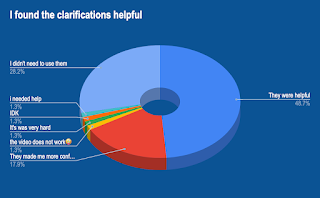
Each quiz ended with an opportunity for the kids to give me feedback, and I used that to help guide me in the process. For example; 49% of the students used the clarifications guide in the prototype, and a further 28% didn't need to use it. Other's found it confusing, and not useful. In further testing I will investigate how to make the clarification guide more useable.


Here are the results from the student feedback;


And here are my reflections on that round of testing


Tuesday, 23 May 2023

Manaiakalani Innovative Teachers - Project Update

As part of the Manaiakalani Innovative Teachers program this year we were asked to identify a problem that we felt was important to address in our classrooms. I identified a focus, and it was that I felt there were students in my class who had a really strong grasp on numeracy, but were limited in performing to the level that they were capable of because they were hindered by their literacy, particularly the comprehension of word problems in math tests like PAT.


The vocabulary can be tricky, the questions lack context, and let's be honest, the scenarios are somehow both weird, and boring. I don't want my kids thinking that math is boring, and I certainly don't want them thinking that reading is either.

My original thought was, unfortunately, deficit minded, and didn't focus on how I could reframe the problem towards building a solution. Alongside my fellow MIT colleagues we spent a wonderful weekend in Omaha breaking each others ideas down, and building them back up towards a forward thinking solution. If you would like to read more about this process check out this blog post about our Omaha Hui

As part of this process we developed a "How might we" statement to help us focus our intentions, and set our minds on the solution.

"How might we support students to unpack maths problems which contain unfamiliar language?"

I returned home inspired, and motivated to create - the first story entitled "Jacob's Village Life"  was trialed in the final week of term across a wide range of Year 5 & 6 students at Pt England School. The prototype was built using Google Forms - this allowed me to seperate the story into sections, to add images, and an accompanying audio track for students to follow along as they read, and hyperlinks to a set of clarification slides to help the unpack the operative words in the questions. See the example below.


At the end of the prototype story the students were asked to give feedback, and while it gave me some things to work on, the elements which were of highest importance to me functioned how I wanted them to - the clarifications helped close to 50% of the students, with close to 30% not needing them at all, and the students wanted more, and the text was interesting, and Forms was easy to navigate for our students. Further investigation into what made the Clarifications confusing for the 18% of students is needed, and is part of the next steps in the process.

I am currently in the process of adding texts to what will eventually be a library of texts with new releases, coming out regularly, covering a range of math, and reading levels to give access to as many students as possible, and extending the clarification slides to include a wider variety of vocabulary words, and math terminology. 


Follow along with this journey as our students explore, and hopefully, become great MathVenturers!

Tuesday, 4 April 2023

Manaiakalani Innovative Teachers - KPMG Hui One

 KPMG Hui - 27th March

We arrived into the city (not so) bright and early this morning for our Hui at the KPMG offices. We have been asked to present 

Present our prototypes 

Feedback 

- extending beyond primary; how can we take away some scaffolding in future to continue extending students, 

- building vocabulary in “Do Now”  type of tasks. Start w/ PAT maths vocabulary and move forward from there.

One of the reflections I have come away with after these discussions and feedback is trying to work out the appropriate levels for my prototype - both language, and maths curriculum levels. I would like this tool to have content accessible to students across all levels, but because there is a wide variety of ability levels (students with good literacy, but low maths ability; students with low level literacy, but high level maths) and how students can self-identify what level they want/need to be working at that is most beneficial for them

Discussing how we can get students to identify what they know already, what their next steps are to progress through this prototype is something that I would like to build on - a systemic levelling system which means that students can self-select what they would like to do, or to work on.

Prototype; MathVentures


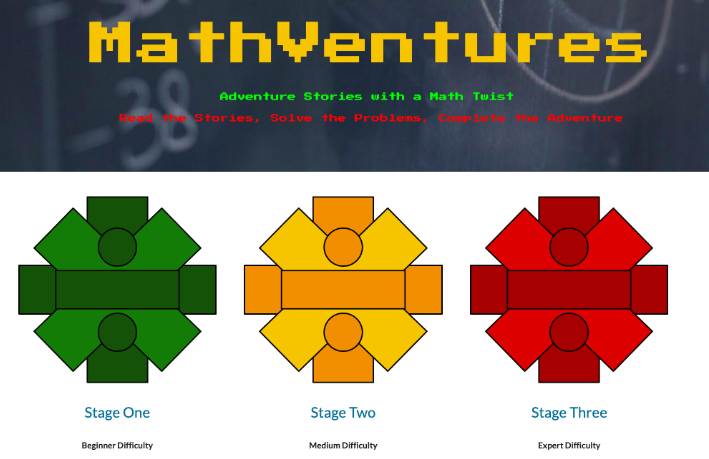
I have built my prototype using Google Forms to present the story, and Google Slides for the clarifications. Google Forms offers a lot of different elements that I need in order to ensure that I am getting an accurate reflection of; student progress, student voice, and because it offers me the ability to create the level/stage element of the story that I want (based on the idea of a choose your own adventure type story that I had originally brainstormed to give it a challenge/game type of feel).

I am currently searching for other online tools that might help me to incorporate all of these elements into the tool, however none that I have been able to use  have the comprehensive coverage that Google Forms offers at the moment.

For my prototype I decided to keep it simple, and to keep the language, and the maths tasks at the same curriculum  level (Level 2) in order to get a wider range of students who would have a wider range of experiences with the text, for example there will be students who read at Level One, for whom the text would have been above their reading level - how do the clarifications and audio help them to understand the questions?; for students who read above and beyond Level 2 - was the text engaging, did the clarifications still help, was the story interesting or engaging enough, even for students who read above the level to find enjoyment in the text.

I rolled out the prototype to 3 Year 6 classes, at the end of Term 1; the data and reflections I have shared below.


Sunday, 5 March 2023

Manaiakalani Innovative Teachers - Part One

2-4rd March 2023 - Omaha Hui


First Night (02/03/23) : 

We arrived at a beautiful house in Omaha  around 6pm, and after some socialising and dinner we settled in to hear the introduction to the Manaiakalani Innovative teachers project from Dorothy Burt. In this presentation she outlined the reasons, the “why” of our project, and shared with us the stories of the innovators that contributed to the early days of Manaiakalani, the endeavourment  they showed in making changes and innovations that have lead to great success and engagement from, not only students, but teachers, academics, and philanthropists that have allowed Manaiakalani to flourish and achieve the success they have had over the years.


I felt inspired listening to the stories, in particular the ones from teachers who HAD to innovate in order to create equity for their students, and their communities. I feel a real privilege to be working under Russell and Dorothy Burt, who have demonstrated time, and time again, the willingness to think outside of the box, to work with entities outside of the traditional schooling system in order to make their schools a critical part of the community, whether that be their work in PNG, or the innovation that lead PES to become the first Google school in New Zealand, or to create a community internet system, not just for their school, but for the entire Tamaki community of schools.


The quote ““If I have seen further, it is by standing on the shoulders of giants.” by Isaac Newton is one that came up time, and time again during this presentation, and resonated with me in a really powerful way. I think it’s extremely important for us, as teachers, to understand how far we have come, and to understand our past in order to properly prepare for our student’s futures.


Full Day Meetings - 

Stage One (Empathy)

  1. Role Playing - teachers were given roles to play as teachers of the imaginary Omaha Area School - each parent had a unique perspective, and situation that impacted what their beliefs were regarding the issues, and problems that the school had addressed (many of the problems raised were the ones we identified in our initial proposals). This exercise allowed us to connect with the problems from a variety of perspectives in order to focus on the Empathise stage of our design process.

  2. Users Task - The next step in the design process is for us to be able to understand the perspectives of our students, as well as ourselves, and other teachers. By understanding the needs of teachers, and students we can more accurately direct the design process towards who needs it more; the students or the teachers. We answered the questions as both the teacher and the student;

  • What does the user do?

  • What does the user say?

  • What does the user think? 

  • What does the user feel?

For my project I  have determined that teachers are in need of a way for students to connect vocabulary that is unfamiliar to them, to strategies with which they are familiar. This will help them to solve worded maths problems with independence and therefore improve their self efficacy, and confidence when approaching these kinds of questions.


Stage Two (Define)

In this next stage of the process we were required to narrow down our idea for our project into a succinct sentence, answering the question “What is the problem that your user is experiencing?”. This was a tricky challenge that required us to distill the problem we had into a succinct and precise sentence, that outlined 

“______ (user) needs____________ because__________ (insight).”


My original statement read as follows; 

Mr X needs a way for students to connect unknown vocabulary with known mathematical strategies because it will help them to independently solve word problems in maths.


We presented our questions, and the feedback I got was that this statement made some big assumptions, that I believe relate back to the idea that correlation is not causation; that because this is a multifaceted problem it is presumptuous to say that this WILL in fact do anything to improve student progress in maths.


How might we? 

Once each teacher had presented their ideas we completed the next part of the task, which is to take on the feedback, and to change our statement and frame it more positively, instead of a X needs X statement it was phrased as “How might we…?”. 

My proposition read as follows; How might we support students to unpack maths problems which contain unfamiliar language?

By framing this in a more positive way, and phrasing it with an opportunistic sentence starter it also helped to further distil the question into a simple and concise proposition that I think will help to guide the next steps of this project in a clear direction.


Stage Three  (Ideate)

Crazy Eights

The next part of our idea exploration was the Crazy 8 task. This required us to come up with 8 different solutions or tools that might work for our problem. From simple to ridiculous we had to think carefully about how we wanted to solve this problem. 

Below you can see the original 8 ideas;

  1. A Maths game by which students must show understanding of a concept or vocabulary to pass to the next level.

  2. A help site by which students can identify what they are having difficulty with and can seek support through definitions, explanations, demonstrations and videos.

  3. A storybook, choose-your-own-adventure style in which students must solve maths problems to find the next page in the story.

  4. A tool where students can ask questions to other students using algorithm (number) questions to write their own word problems (showing both understanding of the numbers, and using words to add their own context.

  5. Booklets, separated by topic with lots of information, and tasks for the students to complete.

  6. A Youtube channel with engaging and interesting videos which can introduce and explain maths concepts to students.

  7. A practical day cross-school where students can engage practically and apply their strategies to real life situations.

  8. A variation of CHAT-GPT in which students can ask questions, for clarification and the AI will provide a definition, a demonstration or a video that shows what it looks like.


After we had come up with these 8 ideas we were asked to present, and explain what they were to the group.

Once we had presented we were given small stickers, and stamps and spent 15 minutes reflecting on the other members' projects, and placed the stickers/stamps on the ideas that resonated with us as being useful, and applicable. FInal step was for us to select one option from each of our group mates options that we thought was the best option.

This feedback was incredibly helpful as it allowed us to see more clearly the primary direction for our projects to head in. As you can see from my sheet above the Storybook option gathered the most stickers, followed by the Student-led questions. For future implementation student input will be incorporated, however for the time being I will pursue ways of creating a digital storybook that requires students to solve problems and answer questions to progress through 


A Brand New Voyage!

  I start, and finish every year off with such a great sense of excitement; Christmas, New Years, and long, merry days in the sun wondering ...