Showing posts with label manaiakalani. Show all posts

Tuesday, 27 January 2026

A Brand New Voyage!


I start, and finish every year off with such a great sense of excitement; Christmas, New Years, and long, merry days in the sun wondering what the LD50 is for ham.

This year brings even more excitement as I venture away from the place I've called home for the last 5 years and begin my journey as a Manaiakalani Facilitator.

If we've never had the pleasure of meeting my name is Gabriel, for the last 4 years I have been a Year 6 teacher at the superb Pt England School. I don't want to reflect on my time there too much, other than to say it has offered me the opportunity for a renaissance in my passion and love for teaching, and I am so grateful to Russell, Kent, Kelsey and all of my family over there. 

I grew up in the Tāmaki / Maungarei area, attending Sylvia Park School and Selwyn College and so it is such a privilege to be able to continue serving this community in the best way I can, returning all it has given to me over the years. 

In my time outside of teaching you can find me on the softball diamond (playing or coaching), on the oche (that's a word only dart nerds know), or trying to lift something heavy. 

I look forward to continuing to share my journey with you all, friends new, and old. Keep an eye out for what I'm getting up to this year.


Wednesday, 19 February 2025

CoL 2025 - Part One

This is my third year reflecting on this very same question; How can I support my lower literacy students with their comprehension of word problems in maths?

Last year I thought I'd worked out an effective solution; use the CPA approach to strengthen their foundational and conceptual understanding, however there was a limitation in this. Most frequently the A in CPA was symbolic, it was using digits, numbers, and operational symbols. It did not address the hole in their understanding that was decoding, and comprehending what the word problems they faced were asking of them. 

THE CPA APPROACH | Smartli | Singapore Math 

For the first time since I began teaching I have struggled to find a focus for my inquiry; not because I haven't identified areas in my student's learning that needs further support, but because for the first time in my own career I am teaching to a structured program.

This year, like all of you, I have been tasked with rolling out a structured Maths program, in our case Scholastic's Pr1me Mathematics, and boy has it been a learning curve. 

PR1ME Mathematics | Scholastic ...

First, let me start by saying I am thoroughly enjoying the program so far; as someone who can be very pedantic about the resources I use in my class I have spent countless hours trying to create learning experiences that are engaging, interesting, and enjoyable for my students to use. Pr1me has done an incredible job of taking that job off my hands.

However, it is through the using of resources not produced by me that I encountered the first obstacle for my students. The first part of the Pr1me program is a diagnostic test. This test is used to determine which Book of the program the students will take on for they year. For our students this was a gruelling experience. 14 pages, back and front. Writing with pencils, instead of their mouse. Questions with a wide variety of difficulties, some straightforward, some multi-step problem solving. This was definitely not something our students were used to. The results of the test spoke for themselves; most students answered between 5-10 of the 30+ questions in the test with some accuracy, or indication of strategic thinking.

After they finished the test, we did a little bit of a debrief; 

How did you find the test? What was the hardest part about it? What did you find most confusing?

There were a wide range of answers, however the fundamental theme throughout them was a lack of understanding around what the question was actually asking them to do. 

I rewrote 3 questions on the board, mimicking the style of questions they had just done in the test. We went through it together, drawing out the key numbers, and finding the operative words in the question. With plenty of support and guidance we ended up turning the word problem into a numerical equation, that the students were able to very easily solve using strategies they had been learning with me.

So where's the barrier; what is it that they are not understanding? It has to be the words. It just has to.

So; here our journey begins. I'm narrowing down my target group, but I am going to look at the students in my class with lower level literacy, and low level of maths, and tracking their progress, as I learn to better support them, now with the structure, (or restrictions) of the Pr1me program.

Follow along to see where how far we'll go!


Monday, 14 October 2024

Cook Islands Summit

In October I was privileged to be a presenter at the 2024 Cook Island Teacher's Summit, and I'll start of by saying WOW. What an awesome experience, and opportunity; to be able to connect and share ideas with a wonderful group of teachers is something that I will always treasure. It is opportunities like this that make me so thankful to be a part of the Manaiakalani family.

I thought it would be cool to share with you what I presented, and share some of the awesome PLD that I got a chance to be a part of;

I'll get mine out the way first. My presentation focused on my inquiry question for 2024 - How can I improve my student's conceptual understanding of mathematical concepts?

This question was one that built on my MIT '23 project of improving students comprehension of word problems, and came about because I realised that vocabulary and comprehension was only a small part of what my students were finding difficult; they also needed support in their retention of basic facts, and number knowledge. Some of them needed additional support through the use of manipulatives to make connections between abstract equations, and the real world applications of them.

This was where T-Shaped Mathematics came from; an adaptation of a learning model that we use in our literacy planning; the idea that in order to improve conceptual understanding of a topic our students must be offered a range of learning opportunities, exercises, and strategies that best suit them. By offering this wide range we can ensure that students can find the one that works best for them.

I have built my mathematics program this year on the foundation of the CPA approach, as well as elements of traditional, and reformist pedagogy; rote learning through the regular practice of multiplication and division, and addition/subtraction through repeatable exercises as warm ups; a range of questions which required the use of manipulatives, both physical and digital, and fun and engaging games that we can play in math that foster collaboration, and learning from their peers. The aim of this was, in simple terms, to do the mahi, and then get the treats. Following this principal has been instrumental in the improved engagement, and results I have seen this year.

Examples of how this is done can be seen in the slides below; 


The best part of the Cook Island Summit, aside from the amazing location, weather, people, and places we got to see, was the opportunity to learn from expert teachers, and to spend the time talking, and sharing ideas with them;

I was fortunate enough to be able to attend some awesome workshops; the first was a workshop entitled Beyond the Reef; presented by Pelu Leaupepetele, the principal of Kedgley Intermediate. This workshop was focused, primarily on leadership in schools, but carried with it some critically important messages, particularly for teachers of primarily Pasifika schools, of vulnerability, honesty, and openness, and how relationships between the leadership, teachers, and students can create a school environment where students and teachers open up, and can share and be vulnerable with each other, and in doing so, can build trusting relationships which foster a school which is healthy, and happy.

The second workshop is one I am very thankful I was able to attend, it was extremely popular, and with good reason. The workshop was titled Ruapekapeka, and the title, which I knew to be a famous battle in the New Zealand Wars, was so much more. Presented by Ian McGee and Tess Whelan from Taylormade Media we were introduced to matautanga.co.nz, an absolutely incredible resource. The ins and out of which I could spend all day writing about, however I simply implore you to explore their resource. It is amazing, and absolutely free. I will 1000% be using this as the foundation for my Aotearoa's History unit starting off 2025.

The first day done and dusted we all gathered together to experience Captain Tama's tour. What an awesome day - I cannot empasise enough just how beautiful the Cook Islands are, and we were gifted an incredible, and hilarious trip out to a small island, maybe 10 minutes by boat from Rarotonga. We were kept fed, and entertained by the wonderful Captains and spent a lush couple of hours swimming, sunbathing, and nearly being eaten by an overly friendly Giant Trevally. 

I will share with you more details about Day 2 of the Summit in another post, because there is simply too much to read in one go.

Wednesday, 27 March 2024

CoL Inquiry - Part One

It's been a couple of weeks since my students sat their PAT Math test, and so I've spent a lot of time reflecting on their results. At the start of each year we use these tests to help us to understand our students better; to see which areas of maths they succeed at, and which ones they are struggling with. 

The target group for my inquiry cycle will be a group named Storm; students in this group have OTJ's which place them around Level 2 of the NZC and they averaged a 3.3 Stanine in PAT testing. 


There are 10 students in this group, and with a group this large there is a wide variety of self-efficacy, interest, and enjoyment when it comes to maths, so, to get a better understanding of who they are as Maths learners I conducted a Student Voice survey; of the 10, only 3 felt that they were "good at math", the others did not know (good news is, none of them thought they were not good). 
They were pretty divided on how they felt about maths; a couple of them used only positive words to describe maths, words like "fun" "interesting" or "exciting", but what was interesting was that almost half of them used the word "stressful" to describe it, including some of those students who also said it was fun, and interesting.

I found this dichotomy super interesting, because, to me, it mirrors my own feelings towards maths. As a student when I encounter concepts that I do not understand, it is stressful. It's like trying to solve a puzzle, but half of the pieces are from another puzzle, no matter how I try to apply my learning and try to make the puzzle pieces fit, they just won't; however, if I find the other pieces, if I strengthen my understanding of a concept, or a formula, or a strategy, suddenly the pieces start to fit, and that is what lead me to the most recent development in my inquiry.

Do my students have a well-rounded understanding of the concepts and vocabulary that we cover? 
Do my students understand that addition is calculating the combination of 2 or more numbers, or that multiplication is the repeated addition of the same number, for example. How do we expect them to apply strategies to concepts that they are not fully aware of? How can they be adaptable, and flexible with their application if they do not first understand what they are being asked?

Without trying to cover the wide spectrum of concepts in the math curriculum I chose to focus on the two areas of maths in which my students achieved the lowest results; Number Strategies, and Algebra, and to work out where their understanding of the concepts within them are.

It is easy to assess their ability to solve problems in these areas, we teach a strategy, we give them a problem, and either they solve it correctly, or they do not. Testing their understanding of the concept is proving to be a little harder. After discussion with my colleagues, and conducting research of my own I could not find anything that fit my needs, GloSS testing where students explain their strategies, and eAsttle tests gave me some insight, but not an umbrella view of what they understand these concepts, and words to actually mean.

What I would like to do is build a diagnostic test, or interview that can assess whether or not they understand what a concept like "addition" is, rather than test their ability to add together numbers.

I'm working on putting together a prototype at the moment, so check back in to see what I've got soon!


Sunday, 19 November 2023

MIT 2023 - The End of the Journey

As my father always told me  "All good things must come to an end", and this MIT journey for 2023 has finally come to an end. It is a bittersweet goodbye. I walk away from this project with a tremendous sense of pride in what we have accomplished together. MIT 2023 has been one of the most significant highlights of my year and has opened up so many opportunities, discussions, conversations, reflections, and friendships that have improved my practice and my outlook on teaching; the value of the MIT project goes far beyond the tools we have created, it is an opportunity to take part in a community of learning that is equal parts fun, inspiring, and motivating.

MathVentures is just the beginning; starting my investigation into math vocabulary has inspired my next inquiry cycle; investigating how we can continue to help our students comprehend the word problems they encounter in maths, and how we can support our students to build a robust math vocabulary that will help them to better understand how maths is applied in more real-world contexts.

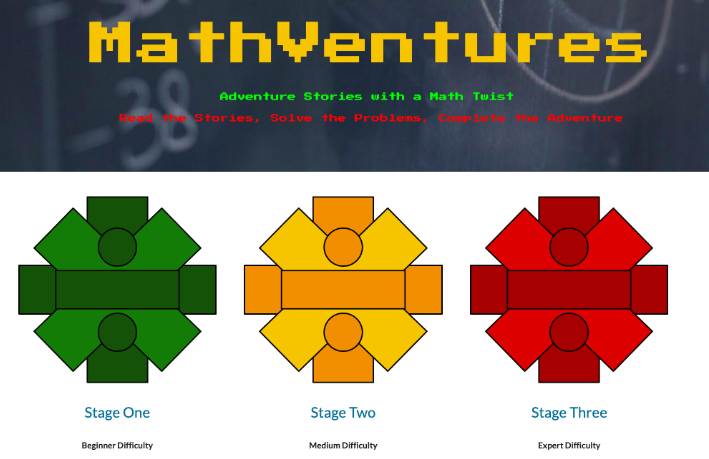
Check out MathVentures here!


 In a way, the end of this journey opens up a door to a whole new set of opportunities to learn and develop my practice, and in turn, improve the outcomes for my akonga. As lifelong learners I think it is so critical for us to continue to pursue these avenues as they open up to us, and while MIT has come to an end this year, it is the start of a whole new journey.

I would like to first acknowledge my fellow MIT alumni for 2023; Crystal, Michelle, Essie, Jayne, and Maiken. You guys have been a blessing to work on this project with. Without the support and encouragement from you guys, I don't know if my project would have reached the stages that it is at now. Thank you so, so much. I am so lucky to have been a part of such a cool crew, and I won't forget our adventures any time soon! That boat trip to Russell is easily one of my favourite memories. 


Secondly, I would like to acknowledge the tremendous work put in by Matt Goodwin, Dorothy Burt, Justine Todd, and Jenny Oxley; the knowledge, experience, and feedback they have given us along our journey have been invaluable, and their contributions to our projects cannot be understated.

I cannot recommend this program highly enough, if you are thinking of applying, please do. You will gain invaluable insights, relationships, and confidence in your own practice that is hard to come by elsewhere.

Kia ora rawa atu,
Gabe


Tuesday, 7 November 2023

Response to Manaiakalani Kāhui Ako - CoL 2023

What achievement challenge are you considering as an area of focus in 2024 and why? Include in your WHY both evidence and your own passion/expertise

The Achievement Challenge I have identified as an area of focus is to lift achievement in maths through the building and development of math vocabulary. For my MIT23 project, MathVentures, I focused on how to help support students unpack maths problems with unfamiliar vocabulary, and while this tool was engaging, and effective I believe I need to develop something more robust in my own practice to help them build the literacy vocabulary needed to accelerate, and perform to their full capabilities in maths. I fundamentally believe that being literate is the key to success in academia; not just in reading prescribed texts, but also in being able to tackle unfamiliar texts, across a range of subjects, and having the confidence in their skills to make sense of increasingly complex, and more subject-specific texts as they continue their learning journeys into intermediate and secondary.

What learnings from the 2017 - 2023 CoL teacher inquiries have informed or inspired your thinking?
Looking over a variety of the different inquiries from CoL teachers I have found a number of them that are focused on accelerating our student's maths progress (Hannah, Clarelle, Elena), and a number that focus on vocabulary building (Robyn, Dianne) but none that I could see which focused on inquiring into our student's subject-specific vocabulary in maths. I feel like there is a great opportunity, which will also align itself with the new developments in NCEA with subjects now having a literacy co-requisite, to build our student's confidence in decoding and comprehending written math problems. I hope, as a result of this inquiry, that my students will feel confident in tackling a wider range of word problems in maths.

How would your work support Manaiakalani pedagogy and kaupapa?
By making my inquiry visible, and accessible to all through both my blog and our Team 4 Class Site I can support teachers through my visible planning, reflections, and my own decision-making processes. Following the Manaiakalani model of "learn create share" I will ensure that not only does the work that my students are doing follow these principles but that my own learning journey through this inquiry mirrors them too.

Which elements of the extensive Manaiakalani research findings inform or challenge you as you think about this?
The data in EdPotential provided by the Manaiakalani Research team, and Woolfe Fisher, as well as a closer examination of my classes' PAT results, indicated to me that there is a need to make an accelerated shift in our progress in maths. Anecdotally I found that a lot of my students had conceptual knowledge of different number strategies, and place value, however, when faced with a word problem that required comprehension, as well as the application of a strategy, they fell short. I would like to undertake an inquiry that focuses on a larger, and more overarching area of maths instruction (vocabulary building) that I feel doesn't get the attention that it needs through deliberate planning and implementation.
How would you like to be supported in 2024 as you undertake this inquiry?
I have applied to be a participant in the Maths Program Intensive as a way of developing my professional understanding of how to construct and plan for maths effectively, as well as any other PLD opportunities that are available. I will also take on all opportunities to discuss my inquiry process with my colleagues and to gather feedback on what they feel they need to best accelerate learners across different levels. I hope to be supported in finding academic research, and PLD that will help me to guide my inquiry.

How would you plan to support your colleagues in your school with their inquiries and/or teaching in the area you are exploring?
As with everything that I do, my findings will be ubiquitous and visible throughout my journey; I am also willing and able to share this process through opportunities like Bursts and Bubbles, the CoL meetings, classroom observations, and the Manaiakalani online toolkits. I will not have all the answers, but through this process, I hope I can engage other teachers, and demonstrate my own learning process in the hopes that it can offer them something by which they can accelerate their learners' progress too.

Monday, 21 August 2023

Reading Practice Intensive - Session Eight

 Session Eight: Creating


As part of my own practice I have always endeavoured to have “Design Tasks” as part of the reading program; usually, a visual task in which students apply what they have learnt in the previous week to create something.


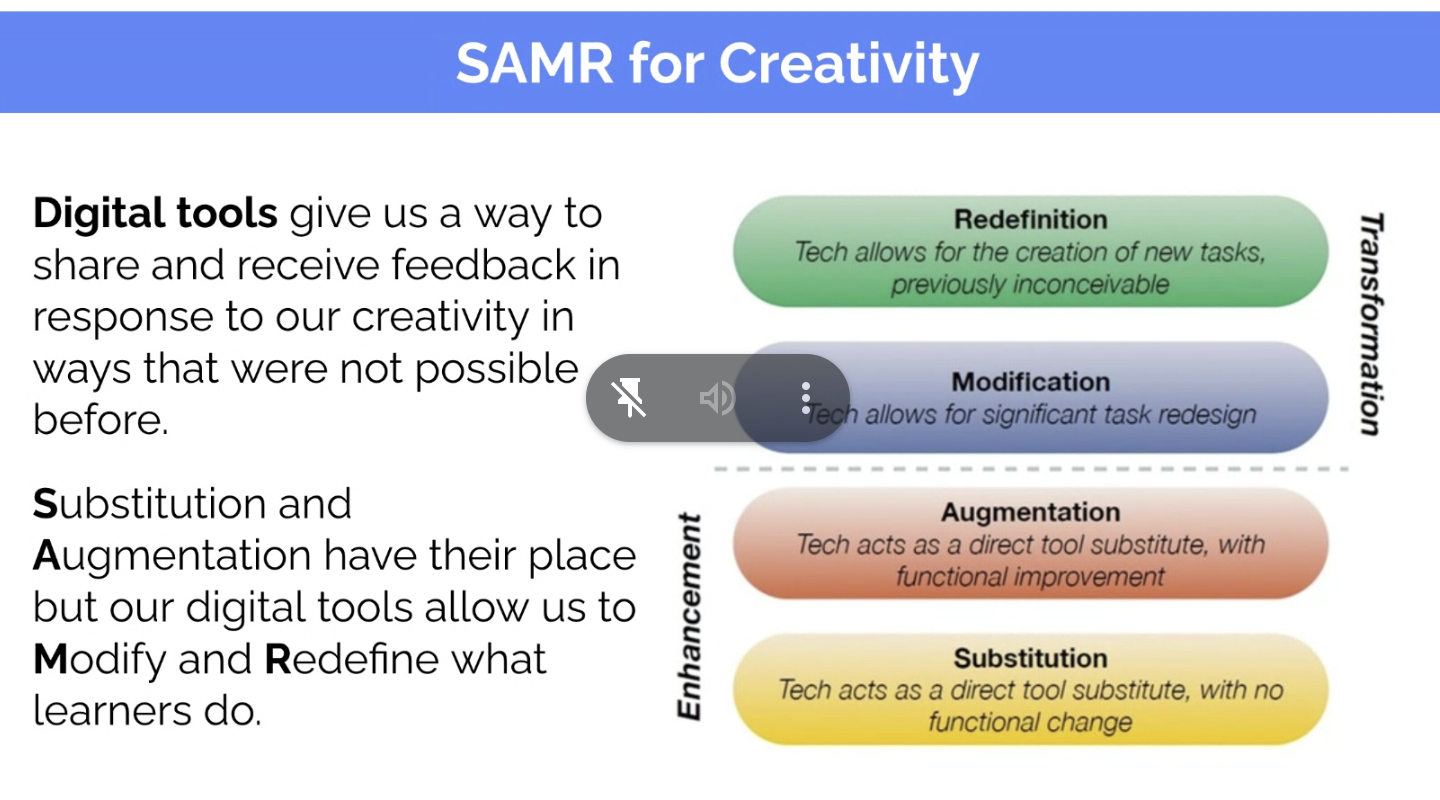
Creating as a response to reading; designing opportunities for students to create interesting, and imaginative responses to the texts they are reading. These tasks are engaging, and allow students to utilise different thought processes, and open up opportunities to try new things, and experiment.


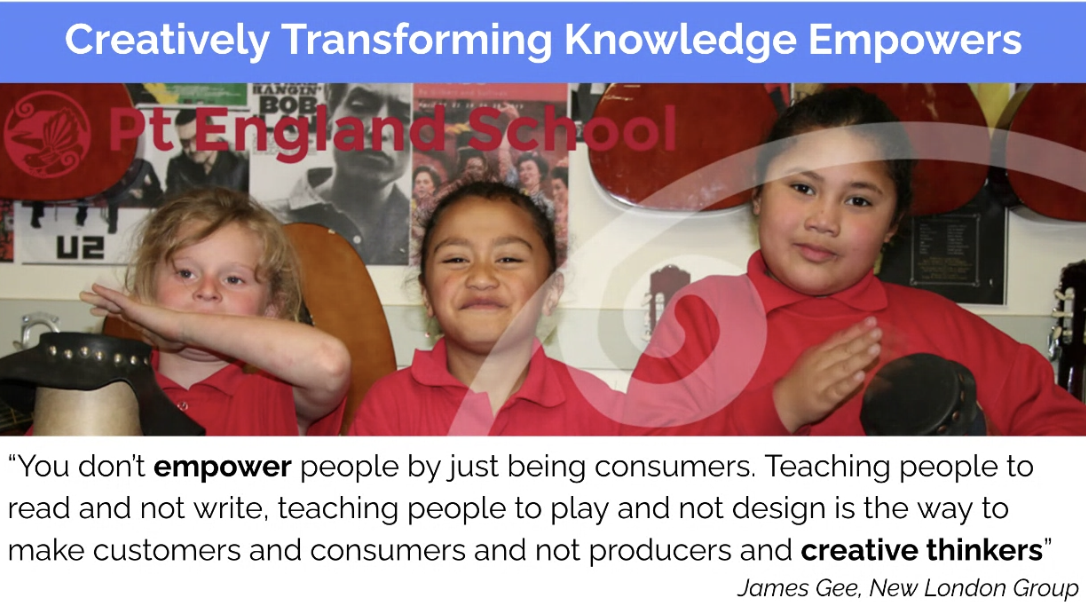
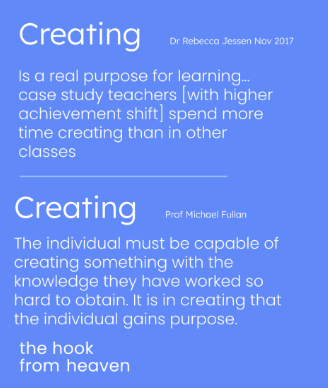
Creating gives our students purpose, and gives them a tangible outcome for the learning that they do, the research shows us that the students who make higher shifts spend a lot of time creating, and applying their learning into making something for themselves, or for others.


Why do we create?

  • Engaging for students

  • Applying their understanding

  • Excercising choice

  • Collaboration with peers

  • Make connections with the learning intentions


“Creativity combines Sight, Sound and Motion with innovation and imagination as well as accuracy, and attention to the last detail” SiSoMo (Saatchi & Saatchi)


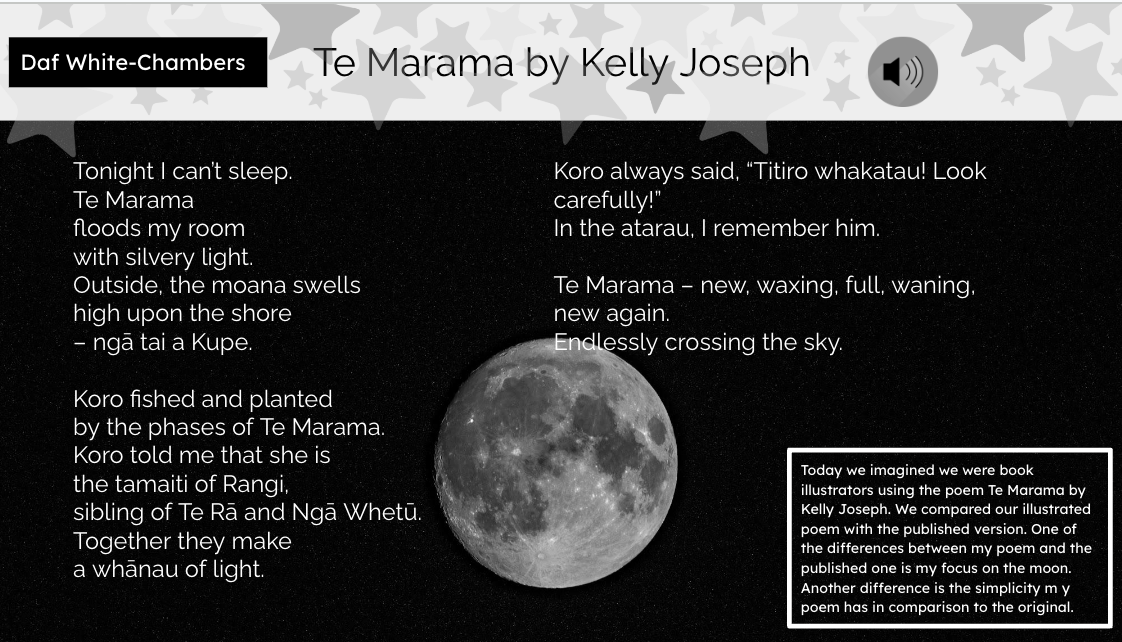
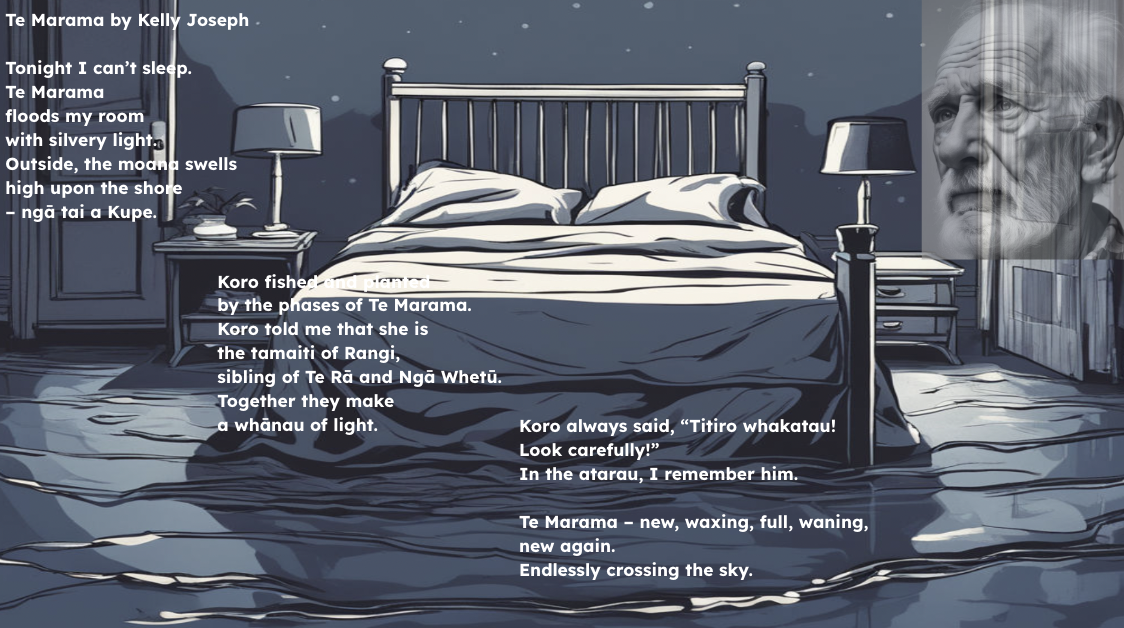
One of our tasks today was to complete a Create task of our own; we were asked to read aloud a poem using expression, and tone which matched the tone of the poem, as well as to create a visual representation of what we were reading. I was amazed at how much of my own interpretation of the poem influenced the image that I came up with, in contrast with what some of the other teachers came up with. This reflects something that I think we all know inherently, is that every reader is going to have their own interpretation of the text, and how it makes them feel. I have included my own, as well as some of my favourites as I think it shows just how open minded, and creative we, as humans, can be.


Why is Creativity so Important? 

The refreshed English curriculum now has a new focus on Creating Texts for themselves or for others which indicates that the Curriculum will take into account how important the Create element of our student’s learning is.

Mayer’s 12 principles of multimedia learning empirically demonstrate the increased learning potential of combining visual and verbal modes (than either mode alone).


Create to Show Learning

How do we fit these Create tasks into our own practice?


  • Short creative responses to texts

  • May involve tighter or looser instructions (Scaffolding for the students to incorporate elements and reflections of our learning into their designs)

  • Involve opportunities for choice to allow students to try different things, and experience new challenges

  • Independent from teacher, but should involve opportunities for collaboration between students and/or the teacher.


There is such a huge variety in the different types of Create tasks, and during this session we have discussed, and reflected on so many. Building a library of these tools is something that I can’t wait to do - it requires a certain type of thinking to come up with original ideas for these tasks, so it’s great to use collaboration, and the skillset of other teachers to be able to borrow tasks and apply them to what we are doing in our classroom.


One of elements I will be focusing on in my own practice is collaboration; there are so many online tools, not just through the Google Suite, that students can work to create together. One of the ideas I had is to get students to create their own Kahoot quizzes to test each other (within reading groups), or between reading groups who may be reading the same text. Another tool I want to explore more is MindMup; this tool appears to allow students to collaborate to create mindmaps based on prompts, or important ideas from the texts that we read. This will allow them to understand different perspectives, and points of view as they work to understand the big ideas in the text.


We were asked to do something else today that I will definitely be borrowing, and using in my own classroom, and that is the One-Shot Book Review. In this task we were asked to promote a book that we enjoyed, and to "sell" it to other readers. The book I chose was "A Light in the Attic" by Shel Silverstein. This book is actually a poetry collection, and one that gave me a love for poetry, which for years I thought was just about describing boring places, and emotions using complex metaphors, and simile. This author showed me that poetry can be fun, and silly, and can use those language features to make poems
MORE interesting, rather than harder to understand. Check out my One-Shot Review below;


In summary, I think it is especially important for our student's engagement to apply their learning in creative, and interesting ways. Their ability to produce interesting, and engaging content of their own opens up a whole new world, especially in the modern day where we are seeing podcasts, TikToks, vlogging, and so many other forms of creative outlets becoming viable outlets for expression, for creativity, and, although not critically important, for monetization. The world is their oyster, and as teachers, we are doing them a disservice if we focus all our time on having kids work on OUR content, instead of using their wonderful minds to make content of their own that they and others can enjoy!

Tuesday, 23 May 2023

Manaiakalani Innovative Teachers - Project Update

As part of the Manaiakalani Innovative Teachers program this year we were asked to identify a problem that we felt was important to address in our classrooms. I identified a focus, and it was that I felt there were students in my class who had a really strong grasp on numeracy, but were limited in performing to the level that they were capable of because they were hindered by their literacy, particularly the comprehension of word problems in math tests like PAT.


The vocabulary can be tricky, the questions lack context, and let's be honest, the scenarios are somehow both weird, and boring. I don't want my kids thinking that math is boring, and I certainly don't want them thinking that reading is either.

My original thought was, unfortunately, deficit minded, and didn't focus on how I could reframe the problem towards building a solution. Alongside my fellow MIT colleagues we spent a wonderful weekend in Omaha breaking each others ideas down, and building them back up towards a forward thinking solution. If you would like to read more about this process check out this blog post about our Omaha Hui

As part of this process we developed a "How might we" statement to help us focus our intentions, and set our minds on the solution.

"How might we support students to unpack maths problems which contain unfamiliar language?"

I returned home inspired, and motivated to create - the first story entitled "Jacob's Village Life"  was trialed in the final week of term across a wide range of Year 5 & 6 students at Pt England School. The prototype was built using Google Forms - this allowed me to seperate the story into sections, to add images, and an accompanying audio track for students to follow along as they read, and hyperlinks to a set of clarification slides to help the unpack the operative words in the questions. See the example below.


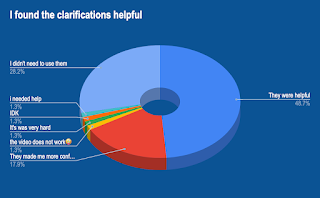
At the end of the prototype story the students were asked to give feedback, and while it gave me some things to work on, the elements which were of highest importance to me functioned how I wanted them to - the clarifications helped close to 50% of the students, with close to 30% not needing them at all, and the students wanted more, and the text was interesting, and Forms was easy to navigate for our students. Further investigation into what made the Clarifications confusing for the 18% of students is needed, and is part of the next steps in the process.

I am currently in the process of adding texts to what will eventually be a library of texts with new releases, coming out regularly, covering a range of math, and reading levels to give access to as many students as possible, and extending the clarification slides to include a wider variety of vocabulary words, and math terminology. 


Follow along with this journey as our students explore, and hopefully, become great MathVenturers!

Tuesday, 4 April 2023

Manaiakalani Innovative Teachers - KPMG Hui One

 KPMG Hui - 27th March

We arrived into the city (not so) bright and early this morning for our Hui at the KPMG offices. We have been asked to present 

Present our prototypes 

Feedback 

- extending beyond primary; how can we take away some scaffolding in future to continue extending students, 

- building vocabulary in “Do Now”  type of tasks. Start w/ PAT maths vocabulary and move forward from there.

One of the reflections I have come away with after these discussions and feedback is trying to work out the appropriate levels for my prototype - both language, and maths curriculum levels. I would like this tool to have content accessible to students across all levels, but because there is a wide variety of ability levels (students with good literacy, but low maths ability; students with low level literacy, but high level maths) and how students can self-identify what level they want/need to be working at that is most beneficial for them

Discussing how we can get students to identify what they know already, what their next steps are to progress through this prototype is something that I would like to build on - a systemic levelling system which means that students can self-select what they would like to do, or to work on.

Prototype; MathVentures


I have built my prototype using Google Forms to present the story, and Google Slides for the clarifications. Google Forms offers a lot of different elements that I need in order to ensure that I am getting an accurate reflection of; student progress, student voice, and because it offers me the ability to create the level/stage element of the story that I want (based on the idea of a choose your own adventure type story that I had originally brainstormed to give it a challenge/game type of feel).

I am currently searching for other online tools that might help me to incorporate all of these elements into the tool, however none that I have been able to use  have the comprehensive coverage that Google Forms offers at the moment.

For my prototype I decided to keep it simple, and to keep the language, and the maths tasks at the same curriculum  level (Level 2) in order to get a wider range of students who would have a wider range of experiences with the text, for example there will be students who read at Level One, for whom the text would have been above their reading level - how do the clarifications and audio help them to understand the questions?; for students who read above and beyond Level 2 - was the text engaging, did the clarifications still help, was the story interesting or engaging enough, even for students who read above the level to find enjoyment in the text.

I rolled out the prototype to 3 Year 6 classes, at the end of Term 1; the data and reflections I have shared below.


Monday, 13 February 2023

Reading Practice Intensive - Session One

The Reading Practice Intensive is a program set up to guide teachers through the development of ideas and plans that will allow us , not only to be better teachers of reading for our students, but to have the tools we need to share, and help our fellow teachers through an area of learning that is hugely critical to the success of our students.


Below are the otes and reflections from our first session.


Overview


Acquiring content and practice which can impact disposition or attitudes towards reading to help students become independent, life-long readers.

Apply knowledge acquired from RPI and pass on that learning to our school.

Reflect on learning w/ mentor and organise 15 min observation (1 per session)

Critical for Manaiakalani teacher’s to accelerate learning in order to create an equitable future for our learners.


“Reading ability has a considerable impact on both educational attainment and wider life outcomes. Research finds robust connections between reading ability and educational success. Reading enjoyment and behaviour appear to be the key mechanisms in this relationship” (Mulcahy et al, 2022)


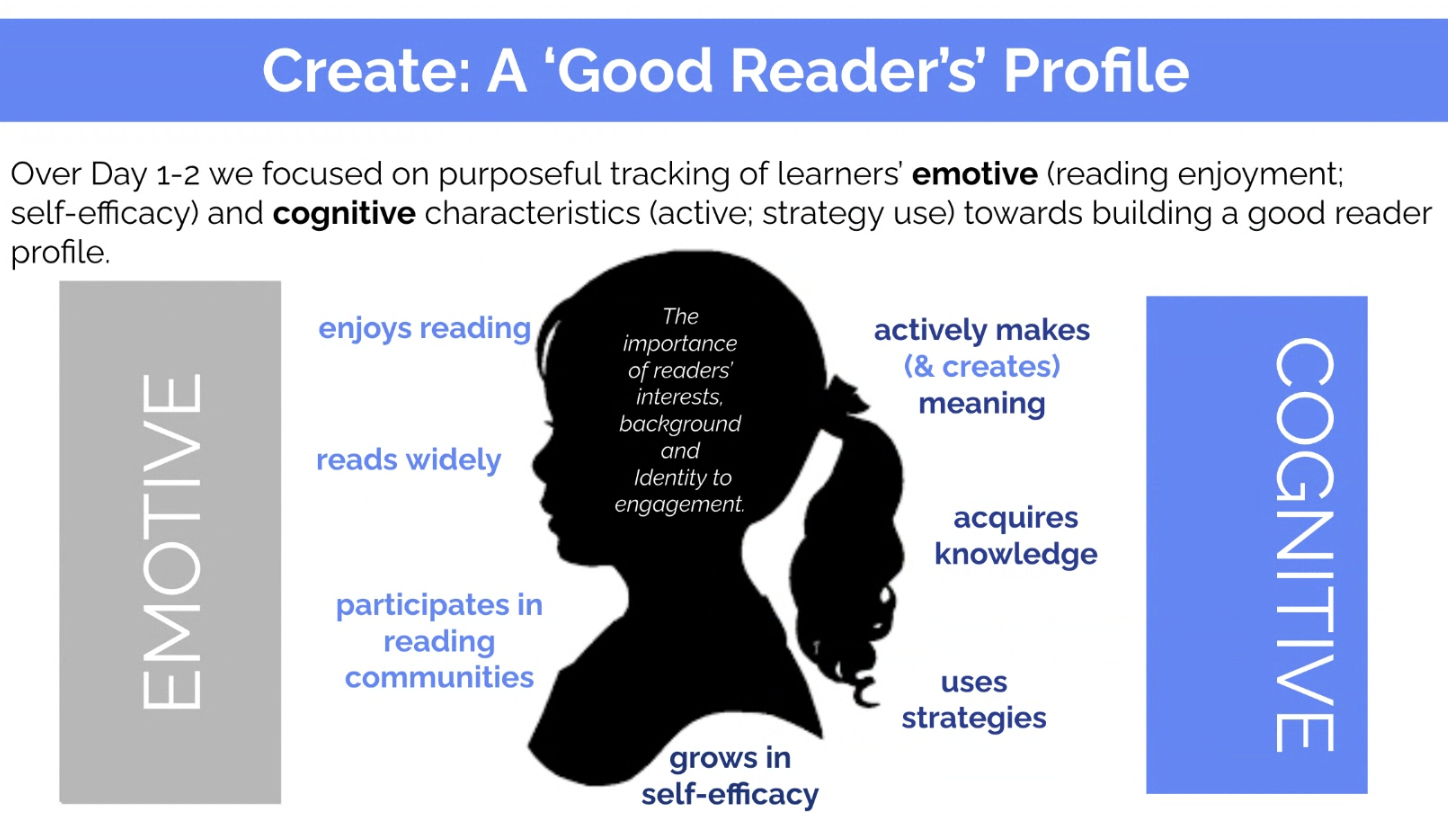
What characterises a good reader?


- Curiosity and hunger to learn more about topics they find engaging.

- Reads for enjoyment and for entertainment, as well as for learning purposes.

- Patience and focus to read for extended periods of time.

- Understanding of how to access and find texts.

- Strategies to make meaning  &  build their confidence (self-efficacy)  to tackle texts which can be challenging. Believing they are capable of carrying out an action to achieve a goal.

- Participate in communities of learning (classrooms, friends, family etc.) to add further learning related to texts through discussion and conversations

- Acquiring, using/applying the knowledge they gather through reading.

- Read a wide variety of texts which engage them with different ideas, and styles.


The use of forms can be critical in this respect as it allows teachers not only to gather data on their attitude towards reading but can also give us an indication of student interests, and self-efficacy when it comes to personal reading choices. This information can also be used by teachers to encourage students to try different texts, and to delve deeper into topics, subjects, or genres that they’re interested in in order to follow the T-Shaped literacy


Teachers as Readers

Teachers help students become readers when they understand the importance of reading for pleasure and are reading role-models.

This requires us to know our students, know the literature they’re reading and to share OUR enthusiasm for reading.

Reading Across the Curriculum

Reading & writing  are things that we do across a wide range of topics, not just something isolated to literacy lessons. (Finding a wide variety of texts/types of texts related to a topic area (T-Shaped Literacy))

Using the library as a valuable asset - used both in teaching context, but also a place for students to explore their own interests and learning areas through a variety of different learning opportunities and resources.

Making explicit connections between content/concepts and other contexts.

Students interpreting and analysing their own/their classes' reading behaviours  and attitudes (in a mathematical/statistical analysis context), not only allows us to teach/talk about literacy in a cross-curricular way, but can help students to feel encouraged, and enthusiastic about improving their reading aptitude and attitude because they take charge of their own learning.

Students encouraging other students, through things like Book Chains, seems to have a really positive effect on student’s attitude towards reading where it is not just something they are being made to do, but rather it’s a form of entertainment that they can share with their friends, like watching a cool new movie, or trying a new video game.

Giving student’s self-directed opportunities for follow up activities is a great way of engaging students with a text through a task that they find interesting/relevant to them and their lives (like TikTok profiles, or text conversations)

I think students encouraging others to read helps them to take the “personal” element out of it which could potentially be discouraging, and turns it into a larger picture of how to change achievement across the class.


A Discussion about Texts

There is a reinforcing reciprocal relationship between oral language influencing reading development, and reading influencing oral language development.

Opportunities to verbalise their ideas is a critical element of learning, but in order to do this we need to have clear, and explicitly taught ground rules around how to talk with one another in these contexts;

- Actively listen (includes not talking over others);

- Respectfully take part giving ideas, reasons and evidence; 

- Ask questions; Be inclusive. invite the participation of others (this is of particular importance when encouraging reciprocity with students);

- Stick to the topic;

- Look at other sides of the issue (e.g. fully informed to think critically & make best decisions)


We got into breakout groups of about 5 teachers, and it was interesting to see how some of the pitfalls that our students will experience were similar to the pitfalls that we encountered, in particular encouraging and inviting others to join the discussion. We need to make sure that we are listening to understand, not listening to respond.

How to grow good readers

Providing balanced book collections at all grade levels is vital to engagement during both reading instruction and self-selection. This work suggests that a balanced collection includes lots of informational titles and a variety of print materials. (Gambrell, n.d) 

Reflections:

What did I learn that increased my understanding of the kaupapa and pedagogy of the Manaiakalani Reading Programme?

It was great to be able to synthesis so may of the different practices I have been taught, and have used in my career as both a secondary English teacher, and as a primary teacher, and how many of these same strategies (self-reflection, explicit teaching of group talk, student choice) are relevant across all learning levels.

What did I learn that could improve my capability and confidence in teaching reading?

I begin the course very confident in my ability to teach reading, and feel reassured that many of the strategies I have put into practice are effective. 

What did I learn that could be used with my learners? 

That including a variety of text types also includes variety in the type of texts they have available (both non-fiction and fiction). I will also be including more student-selected work options for post-reading activities t account for different interests, and learning styles.

What did I learn that could be shared within my wider community, with either colleagues, or whānau/aiga? 

That modelling reading is critically important,  firstly, it begins with reading at home, whether that be reading to kids, reading for enjoyment so that the kids can see, or even just having books in the house that are available for them to pick up, examine, and potentially enjoy.


Thursday, 26 May 2022

Digital Fluency Intensive - Session 4

 Session Four - Dealing with Data


Sharing

“Every person on the planet has the potential to live life as the star of their own movie -  not only sharing the daily minutiae, but also the commentary, the analysis of it and creating collections of feedback and feed-forward.”- DJ Burt

Human beings have an instinct to share; how can we channel that instinct into genuine learning experiences? 

Allowing students to share their learning creates a community of engagement, and gives students a sense of pride seeing how other people engage with the work they have been doing - it also encourages students to create work which is thorough, properly finished, and writing descriptions for their blog also gives them time to reflect and summarise their learning experiences.

Giving students the opportunity to have an authentic audience (i.e edublog) will help them to raise achievement outcomes, and for students to develop a real sense of pride in the work that they have created, and the learning they’ve done. An authentic audience, as defined under Manaiakalani, are the people who CHOOSE to listen to you.

Sharing with;

- One another

- The class

- The school

- The local community

- Global communities (digital age)

Blogging was the  choice for students to share their learning for different reasons;

It resembles the spaces our young people want to be on (youtube, facebook, etc.)

We are able to provide legal, safe, secure provisions for students

Used by teachers and students

Allows for engagement, and interaction between creator and audience (going back to authentic audiences)

Spaces like Facebook, while useful, are open, and not safe for students to share personal information.

Allows for students to create a SMART digital footprint.


We share to show the process, but also to help students understand what “finished” looks like; that it is ready to share. A life-long lesson to learn, we use the acronym FIOP at Pt England for our learning; to finish it off properly. 

Google Forms

Google Forms is something I am very familiar with, we used it frequently in my time as a high school teacher;

Quizzes for students, and allows for easy collection of date - transferable to Sheets so collation of data is helpful

Feedback about what they found difficult, challenging or needed help with.

Use for interaction with families - to gather information, find helpers, get feedback etc.

Useful for gathering information quickly, and is more engaging than just responding to an email when getting into contact with adults who can be busy.


Google Sheets

Google Sheets is very similar, and has a lot of the same functionality as Microsoft Excel which is helpful as I can use a lot of my prior learning/knowledge to help.

This is a very powerful tool when organising, filtering data, particularly when creating groups based on reading age for example, or to arrange students into priority groups based on test results, or feedback from a Google Form.

In a digital age it is so important that we allow tools, like Sheets, to assist us to use critically important data to guide our teaching practices; whether that's for organisational purposes, for streaming students, or to identifying outliers who may need further assistance, or pushing depending on where they fall on the spectrum of results.

Here is an example of data that has been turned into a table; comparing two student's blog posts between 2015 and 2021. As you can see the Y Axis does not show accurately the number of posts, however it is useful for making comparisons between two different elements of data.

A Brand New Voyage!

  I start, and finish every year off with such a great sense of excitement; Christmas, New Years, and long, merry days in the sun wondering ...