Tuesday, 4 April 2023

Manaiakalani Innovative Teachers - KPMG Hui One

 KPMG Hui - 27th March

We arrived into the city (not so) bright and early this morning for our Hui at the KPMG offices. We have been asked to present 

Present our prototypes 

Feedback 

- extending beyond primary; how can we take away some scaffolding in future to continue extending students, 

- building vocabulary in “Do Now”  type of tasks. Start w/ PAT maths vocabulary and move forward from there.

One of the reflections I have come away with after these discussions and feedback is trying to work out the appropriate levels for my prototype - both language, and maths curriculum levels. I would like this tool to have content accessible to students across all levels, but because there is a wide variety of ability levels (students with good literacy, but low maths ability; students with low level literacy, but high level maths) and how students can self-identify what level they want/need to be working at that is most beneficial for them

Discussing how we can get students to identify what they know already, what their next steps are to progress through this prototype is something that I would like to build on - a systemic levelling system which means that students can self-select what they would like to do, or to work on.

Prototype; MathVentures


I have built my prototype using Google Forms to present the story, and Google Slides for the clarifications. Google Forms offers a lot of different elements that I need in order to ensure that I am getting an accurate reflection of; student progress, student voice, and because it offers me the ability to create the level/stage element of the story that I want (based on the idea of a choose your own adventure type story that I had originally brainstormed to give it a challenge/game type of feel).

I am currently searching for other online tools that might help me to incorporate all of these elements into the tool, however none that I have been able to use  have the comprehensive coverage that Google Forms offers at the moment.

For my prototype I decided to keep it simple, and to keep the language, and the maths tasks at the same curriculum  level (Level 2) in order to get a wider range of students who would have a wider range of experiences with the text, for example there will be students who read at Level One, for whom the text would have been above their reading level - how do the clarifications and audio help them to understand the questions?; for students who read above and beyond Level 2 - was the text engaging, did the clarifications still help, was the story interesting or engaging enough, even for students who read above the level to find enjoyment in the text.

I rolled out the prototype to 3 Year 6 classes, at the end of Term 1; the data and reflections I have shared below.


Monday, 27 March 2023

Reading Practice Intensive - Session Three (Text Selection)


Texts are the foundation by which we form a love of reading, and both forms of texts have a really important part to play in our reading  journeys,

What are we going to give them to read that will boost both their cognitive sides, and their emotive sides? What will engage them academically, and what will they enjoy reading?

Windows/Mirrors: Looking at texts which not only allow children to experience the world through the eyes of others, but also to use texts in which students can see “themselves”; a reflection of themselves in the texts. This allows students to form stronger connections to the characters.

Window texts will expand their perspectives on the wider world through the eyes of others, and to experience things that they might not get the opportunity to experience in their own lives.

Learner selected texts are also incredibly important, it removes our own biases and centricity of our ideas as teachers. It is something that we have to be really conscious of, in particular when teaching children from the wide variety of backgrounds that we have in our classrooms.

Choosing texts at the appropriate level helps us to accelerate students. Focusing on texts which lie in the “Instructional” level will help children to reach that “Zone of Proximal Development” which accelerates their learning, and pushes them to take on more challenging texts as their comprehension increases.


Grouping

In our classes we use levelled grouping, basing our groups on their reading ages, however there are limitations to this, mainly that we’re limiting our students' opportunities to perspectives of children at a similar level, but not the ones of others.

If we use grouping with students at multiple levels, we give students the opportunity to talk about texts more deeply; the vocabulary, and comprehension is not the goal, rather to use the texts to generate ideas, and discuss those ideas with one another. Within these groups it is important for us to have contextual knowledge to help them make sense of the ideas, and to make connections between the text, and their own understandings and experiences.

We watched a video called “Flea in a Glass Jar” - a flea is raised in a glass jar, and is limited in his jumping by the lid on the jar, once the lid is removed the flea is still unable to jump higher than where the lid was. This metaphor is important as we ensure that our children are not in a “glass jar”. We need to constantly assess what will work best for them, and ensure that we don’t limit them by keeping them in the same groups all year, and not extending them.


Text Selection

In this session we discussed how to select texts for our students, and there are a lot of things to take into account;

  • Student’s reading levels
  • Prior knowledge
  • Vocabulary
  • Themes and ideas that are important and relevant to them.
  • Skills and strategies we want to work on
  • Student interests
  • Text types which cover a range of modes.

Different ways of reading

It is important for our students to be given many different opportunities to read, however independent reading, while important, is not the only way of approaching content with our students. There is;

Reading to students & Shared reading; a great opportunity to model different comprehension and decoding strategies with students

Paired reading; a great way to generate discussions amongst students who are reading a common texts, having them share their ideas with one another helps them to gain an understanding of other people’s perspectives.

Summary

Today’s learning has really driven home some important points regarding how we select texts, or students select texts and what it’s importance is in regards to engaging students, and helping to extend and support them in their learning. If we can help students to read texts which have mirrors, and windows to extend their understanding of the world, and to engage them with texts that can allow them to apply their strategies in a way which keeps them interested and engaged with their learning.


Reflections

It has been awesome today reinforcing that some of the strategies that I have already implemented in my teaching are ones which help extend our students. Moving forward I would like to improve on;

Using different types of groups (flexi-groups) can expose students to a wider variety of insights, opinions, and experiences. It also helps to improve their own self efficacy because they don't feel constrained by their levelled grouping. Sometimes the levelled grouping, especially if they don’t feel there is room to move they can become discouraged, and feel less confident in their own reading abilities and feel like they are not making adequate progress (even though they might be)

Explicit teaching of comprehension and decoding strategies is something I need to put more work into - it is easy for me to start heading towards more complex analysis type of strategies with students because of my own secondary  teaching background, but making sure to slow down, and model some of the strategies that I may already be assuming the students feel confident with, when they may be struggling.

Incorporating different reading opportunities for students is something I hope to do more of, in particular paired reading, and shared reading, as it gives more opportunity for discussion, this will lend itself well to my inquiry which is focused on expressing and sharing opinions orally in group discussions.


Monday, 6 March 2023

Reading Practice Intensive - Session Two

 Kaupapa and Shared Pedagogy (Valued Reading Outcomes)

Learn Create Share originally grew out of a common literacy practice model in the form of a literacy cycle, and the incorporation of digital technology into their learning practices. Technology was able to hook students who were disengaged with reading in particular by offering a wide range of creative opportunities based on the texts they were reading. Students knew they got to DO something with their learning.

A big part of this is helping students to create “communities of learning” something that was in practice with teachers, but had not yet been considered with students. This took form for Manaiakalani as a podcast called “Korero Pt England” in which students could reflect, and review the texts they had read, and gained a lot of traction, making it into podcast charts (ESOL students listened to it because it was at a level that was appropriate for their level of literacy).


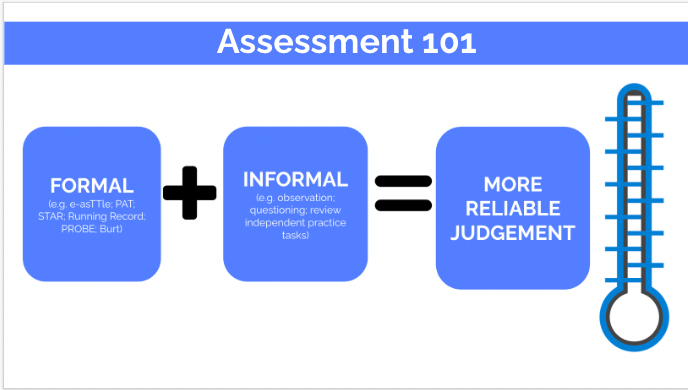
Collecting Assessment Data - Using formative and summative assessments to evaluate our learning practices 

- Tracking our data and goals

- Use the NZC

- Using assessment tools.

Teacher Workbook

We have been given a copy of a spreadsheet in which we can collect, examine, and analyse the data we gather on our children over the years. These assessments for us are the STAR tests, PAT Reading (Scale Scores and Stanines), and Running Records (PM + Probes)

We did a Deep Dive into PAT: Reading Data, and the different reports that this test can provide us.

By examining our class, and analysing the data to identify gaps in their knowledge we can approach the next steps task in order to fill those gaps.

This is a time consuming process, however it is crucial in order to understand the more specific elements of literacy that our students need acceleration in to achieve at or above the national norms.

This teacher workbook functions well as an “one stop shop” for all of our reading practices, from data, to reflection, to planning. I think it will allow a more streamlined approach to planning without having to manage umpteen different sheets, and docs, and to be able to see more clearly what our next steps are when preparing and planning learning.


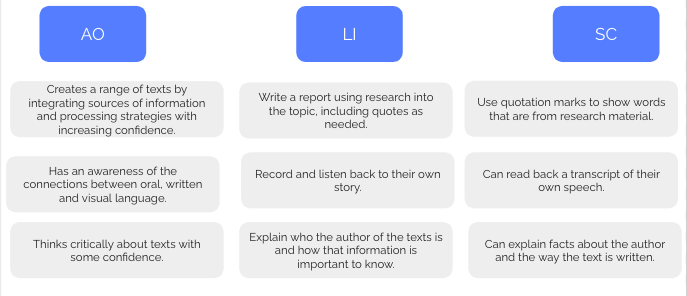
Learning Intentions and Achievement Objectives

One of the clear outcomes to student success is setting clear learning intentions by which students understand what they are trying to achieve, and what they should be able to achieve by the end of the unit.

Ultimately we would like students to be able to co-construct these Learning Intentions with our students in order for them to be self-evaluative, and assess their own outcomes, and success.

This session has given us a long to think about, as it’s an amalgamation of any different pieces of information, particularly how we can best utilise data to make informed decisions about our practice. Moving forward, I am going to look more closely at the gaps in my students' learning, as opposed to broadly trying to cover as much of the curriculum as possible, instead focusing on deliberate achievement objectives until the success criteria I / we have identified has been accomplished.


Sunday, 5 March 2023

Manaiakalani Innovative Teachers - Part One

2-4rd March 2023 - Omaha Hui


First Night (02/03/23) : 

We arrived at a beautiful house in Omaha  around 6pm, and after some socialising and dinner we settled in to hear the introduction to the Manaiakalani Innovative teachers project from Dorothy Burt. In this presentation she outlined the reasons, the “why” of our project, and shared with us the stories of the innovators that contributed to the early days of Manaiakalani, the endeavourment  they showed in making changes and innovations that have lead to great success and engagement from, not only students, but teachers, academics, and philanthropists that have allowed Manaiakalani to flourish and achieve the success they have had over the years.


I felt inspired listening to the stories, in particular the ones from teachers who HAD to innovate in order to create equity for their students, and their communities. I feel a real privilege to be working under Russell and Dorothy Burt, who have demonstrated time, and time again, the willingness to think outside of the box, to work with entities outside of the traditional schooling system in order to make their schools a critical part of the community, whether that be their work in PNG, or the innovation that lead PES to become the first Google school in New Zealand, or to create a community internet system, not just for their school, but for the entire Tamaki community of schools.


The quote ““If I have seen further, it is by standing on the shoulders of giants.” by Isaac Newton is one that came up time, and time again during this presentation, and resonated with me in a really powerful way. I think it’s extremely important for us, as teachers, to understand how far we have come, and to understand our past in order to properly prepare for our student’s futures.


Full Day Meetings - 

Stage One (Empathy)

  1. Role Playing - teachers were given roles to play as teachers of the imaginary Omaha Area School - each parent had a unique perspective, and situation that impacted what their beliefs were regarding the issues, and problems that the school had addressed (many of the problems raised were the ones we identified in our initial proposals). This exercise allowed us to connect with the problems from a variety of perspectives in order to focus on the Empathise stage of our design process.

  2. Users Task - The next step in the design process is for us to be able to understand the perspectives of our students, as well as ourselves, and other teachers. By understanding the needs of teachers, and students we can more accurately direct the design process towards who needs it more; the students or the teachers. We answered the questions as both the teacher and the student;

  • What does the user do?

  • What does the user say?

  • What does the user think? 

  • What does the user feel?

For my project I  have determined that teachers are in need of a way for students to connect vocabulary that is unfamiliar to them, to strategies with which they are familiar. This will help them to solve worded maths problems with independence and therefore improve their self efficacy, and confidence when approaching these kinds of questions.


Stage Two (Define)

In this next stage of the process we were required to narrow down our idea for our project into a succinct sentence, answering the question “What is the problem that your user is experiencing?”. This was a tricky challenge that required us to distill the problem we had into a succinct and precise sentence, that outlined 

“______ (user) needs____________ because__________ (insight).”


My original statement read as follows; 

Mr X needs a way for students to connect unknown vocabulary with known mathematical strategies because it will help them to independently solve word problems in maths.


We presented our questions, and the feedback I got was that this statement made some big assumptions, that I believe relate back to the idea that correlation is not causation; that because this is a multifaceted problem it is presumptuous to say that this WILL in fact do anything to improve student progress in maths.


How might we? 

Once each teacher had presented their ideas we completed the next part of the task, which is to take on the feedback, and to change our statement and frame it more positively, instead of a X needs X statement it was phrased as “How might we…?”. 

My proposition read as follows; How might we support students to unpack maths problems which contain unfamiliar language?

By framing this in a more positive way, and phrasing it with an opportunistic sentence starter it also helped to further distil the question into a simple and concise proposition that I think will help to guide the next steps of this project in a clear direction.


Stage Three  (Ideate)

Crazy Eights

The next part of our idea exploration was the Crazy 8 task. This required us to come up with 8 different solutions or tools that might work for our problem. From simple to ridiculous we had to think carefully about how we wanted to solve this problem. 

Below you can see the original 8 ideas;

  1. A Maths game by which students must show understanding of a concept or vocabulary to pass to the next level.

  2. A help site by which students can identify what they are having difficulty with and can seek support through definitions, explanations, demonstrations and videos.

  3. A storybook, choose-your-own-adventure style in which students must solve maths problems to find the next page in the story.

  4. A tool where students can ask questions to other students using algorithm (number) questions to write their own word problems (showing both understanding of the numbers, and using words to add their own context.

  5. Booklets, separated by topic with lots of information, and tasks for the students to complete.

  6. A Youtube channel with engaging and interesting videos which can introduce and explain maths concepts to students.

  7. A practical day cross-school where students can engage practically and apply their strategies to real life situations.

  8. A variation of CHAT-GPT in which students can ask questions, for clarification and the AI will provide a definition, a demonstration or a video that shows what it looks like.


After we had come up with these 8 ideas we were asked to present, and explain what they were to the group.

Once we had presented we were given small stickers, and stamps and spent 15 minutes reflecting on the other members' projects, and placed the stickers/stamps on the ideas that resonated with us as being useful, and applicable. FInal step was for us to select one option from each of our group mates options that we thought was the best option.

This feedback was incredibly helpful as it allowed us to see more clearly the primary direction for our projects to head in. As you can see from my sheet above the Storybook option gathered the most stickers, followed by the Student-led questions. For future implementation student input will be incorporated, however for the time being I will pursue ways of creating a digital storybook that requires students to solve problems and answer questions to progress through 


Monday, 13 February 2023

Reading Practice Intensive - Session One

The Reading Practice Intensive is a program set up to guide teachers through the development of ideas and plans that will allow us , not only to be better teachers of reading for our students, but to have the tools we need to share, and help our fellow teachers through an area of learning that is hugely critical to the success of our students.


Below are the otes and reflections from our first session.


Overview


Acquiring content and practice which can impact disposition or attitudes towards reading to help students become independent, life-long readers.

Apply knowledge acquired from RPI and pass on that learning to our school.

Reflect on learning w/ mentor and organise 15 min observation (1 per session)

Critical for Manaiakalani teacher’s to accelerate learning in order to create an equitable future for our learners.


“Reading ability has a considerable impact on both educational attainment and wider life outcomes. Research finds robust connections between reading ability and educational success. Reading enjoyment and behaviour appear to be the key mechanisms in this relationship” (Mulcahy et al, 2022)


What characterises a good reader?


- Curiosity and hunger to learn more about topics they find engaging.

- Reads for enjoyment and for entertainment, as well as for learning purposes.

- Patience and focus to read for extended periods of time.

- Understanding of how to access and find texts.

- Strategies to make meaning  &  build their confidence (self-efficacy)  to tackle texts which can be challenging. Believing they are capable of carrying out an action to achieve a goal.

- Participate in communities of learning (classrooms, friends, family etc.) to add further learning related to texts through discussion and conversations

- Acquiring, using/applying the knowledge they gather through reading.

- Read a wide variety of texts which engage them with different ideas, and styles.


The use of forms can be critical in this respect as it allows teachers not only to gather data on their attitude towards reading but can also give us an indication of student interests, and self-efficacy when it comes to personal reading choices. This information can also be used by teachers to encourage students to try different texts, and to delve deeper into topics, subjects, or genres that they’re interested in in order to follow the T-Shaped literacy


Teachers as Readers

Teachers help students become readers when they understand the importance of reading for pleasure and are reading role-models.

This requires us to know our students, know the literature they’re reading and to share OUR enthusiasm for reading.

Reading Across the Curriculum

Reading & writing  are things that we do across a wide range of topics, not just something isolated to literacy lessons. (Finding a wide variety of texts/types of texts related to a topic area (T-Shaped Literacy))

Using the library as a valuable asset - used both in teaching context, but also a place for students to explore their own interests and learning areas through a variety of different learning opportunities and resources.

Making explicit connections between content/concepts and other contexts.

Students interpreting and analysing their own/their classes' reading behaviours  and attitudes (in a mathematical/statistical analysis context), not only allows us to teach/talk about literacy in a cross-curricular way, but can help students to feel encouraged, and enthusiastic about improving their reading aptitude and attitude because they take charge of their own learning.

Students encouraging other students, through things like Book Chains, seems to have a really positive effect on student’s attitude towards reading where it is not just something they are being made to do, but rather it’s a form of entertainment that they can share with their friends, like watching a cool new movie, or trying a new video game.

Giving student’s self-directed opportunities for follow up activities is a great way of engaging students with a text through a task that they find interesting/relevant to them and their lives (like TikTok profiles, or text conversations)

I think students encouraging others to read helps them to take the “personal” element out of it which could potentially be discouraging, and turns it into a larger picture of how to change achievement across the class.


A Discussion about Texts

There is a reinforcing reciprocal relationship between oral language influencing reading development, and reading influencing oral language development.

Opportunities to verbalise their ideas is a critical element of learning, but in order to do this we need to have clear, and explicitly taught ground rules around how to talk with one another in these contexts;

- Actively listen (includes not talking over others);

- Respectfully take part giving ideas, reasons and evidence; 

- Ask questions; Be inclusive. invite the participation of others (this is of particular importance when encouraging reciprocity with students);

- Stick to the topic;

- Look at other sides of the issue (e.g. fully informed to think critically & make best decisions)


We got into breakout groups of about 5 teachers, and it was interesting to see how some of the pitfalls that our students will experience were similar to the pitfalls that we encountered, in particular encouraging and inviting others to join the discussion. We need to make sure that we are listening to understand, not listening to respond.

How to grow good readers

Providing balanced book collections at all grade levels is vital to engagement during both reading instruction and self-selection. This work suggests that a balanced collection includes lots of informational titles and a variety of print materials. (Gambrell, n.d) 

Reflections:

What did I learn that increased my understanding of the kaupapa and pedagogy of the Manaiakalani Reading Programme?

It was great to be able to synthesis so may of the different practices I have been taught, and have used in my career as both a secondary English teacher, and as a primary teacher, and how many of these same strategies (self-reflection, explicit teaching of group talk, student choice) are relevant across all learning levels.

What did I learn that could improve my capability and confidence in teaching reading?

I begin the course very confident in my ability to teach reading, and feel reassured that many of the strategies I have put into practice are effective. 

What did I learn that could be used with my learners? 

That including a variety of text types also includes variety in the type of texts they have available (both non-fiction and fiction). I will also be including more student-selected work options for post-reading activities t account for different interests, and learning styles.

What did I learn that could be shared within my wider community, with either colleagues, or whānau/aiga? 

That modelling reading is critically important,  firstly, it begins with reading at home, whether that be reading to kids, reading for enjoyment so that the kids can see, or even just having books in the house that are available for them to pick up, examine, and potentially enjoy.


Thursday, 25 August 2022

Reading Practice Intensive - Session One

First, I must say that it is a privilege to be a part of this pilot; reading is a critically important part of any child's education, and for those who struggle with it, or do not have the confidence needed for self efficacy it is important for us as teachers to take a hard look at how we teach reading in our classrooms, and to work together to develop a plan to accelerate our learners to reach their full potential.

What did I learn that increased my understanding of the kaupapa and pedagogy of the Manaiakalani Reading Programme?
The Manaiakalani Pedagogy allows for us to place our own learning, and strategies into a ore contemporary framework, one that views education through a modern lens, where it is not simply the student's job to learn, but also to give them the opportunities to create, and to share their opinions, viewpoints, and ideas with the world. Reading is a lens through which to view the world, and by developing higher-level reading skills we help our students to become more critically minded, and through that mastery, take control of their own learning.

What did I learn that could improve my capability and confidence in teaching reading?
I think through this program it will allow me to fine-tune my practice for the primary sector; having trained as a secondary English teacher reading has been a very analytical topic, where students have a certain amount of background/prior knowledge on a wider variety of topics, whereas with primary students a lot of the reading they are doing is their first introduction to a topic. By building a robust plan on how to best deliver reading content we can create a more cohesive literacy program for our students that works for them.

What did I learn that could be used with my learners? 
The importance of student choice is something I will be more conscious of in my own planning; not necessarily giving students free reign over subject matter, but to allow students to conduct their own research, to locate, and find books in libraries, or book collections on subject matter which is interesting to them then we can increase engagement across the board.

What did I learn that could be shared within my wider community, with either colleagues, or whānau/aiga? 
Starting off I would share with them the importance of student choice in their own self-efficacy, and how allowing students choices will increase engagement, and with increased engagement comes motivation, with motivation comes mastery, and with mastery comes confidence to repeat those patterns with different topics, and eventually with reading in general.

This program, once up and running, will be a very effective tool, allowing for reflection, conversation, discussion, and co-construction of practical ideas which will help to accelerate our students.

Sunday, 3 July 2022

Digital Fluency Intensive - Session Ten: External Recognition


As all good things must do, our journey through DFI has come to an end. 

It has been an awesome experience, learning, creating, and sharing with our fellow teachers, just like our students do, and really drives home the importance of continuing to develop our own learning programs to reflect the changing world around us.

It can be so easy to fall back on traditional methodology, and pedagogy, however the course has challenged us to reflect on those things, and to ask ourselves "How are we, as teachers, readying our students for learning in a digital world?" "How can we create adaptable, and resilient learners?" "How can we teach our students to navigate the vast digital world around them in intelligent ways?"


Over the last 10 weeks we have covered a multitude of different ideas, and learning areas, from basic elements like how to use Docs, Sheets, and Drawings, to more advanced coding mechanics, computational thinking, multimodal, and multi-textual learning experiences. All of these things work together to create a community of learners and teachers who are well-rounded, self-driven, and motivated to learn more, because they know the best ways to do it.

It is easy for us as teachers to reflect on what we already do, and fit our current teaching into these frameworks, and say "DONE!", but if we are truly going to prepare ourselves, and our students for the technological changes that happen in the future, we must be ready to reevaluate what it means to learn, create, and share in this new digital landscape, and adjust our practices accordingly.

We are no longer the gatekeepers on knowledge, as our teachers were, where what the said was the gospel truth, and only later in life did we unlearn some of the misinterpretations, or misunderstandings they may have had... looking at you, I before E except after C...; instead our job as teachers is more of a pastoral role, a shepherd, who guides and helps navigate their students through the masses of information they now have at their fingertips, to differentiate the reliable, the credible, and the usefulness of their experiences. Who gives them the awareness to understand how they present themselves online, and create an image of themselves in the digital world. 

We no longer talk about "safe" we talk about "smart", empowering our students instead of frightening them. By giving them ownership, and agency over what they learn, create, and share online we help them to develop good practices that allow them to thrive in the digital space, and to share their experiences with others, so that they might do the same.

I want to thank our facilitators; Dorothy, Matt, Naomi, and Vicki who have shown great patience, and wisdom in helping us over the last 10 weeks, I can't wait to put everything you've taught us into practice, one step at a time.

A Brand New Voyage!

  I start, and finish every year off with such a great sense of excitement; Christmas, New Years, and long, merry days in the sun wondering ...