Monday, 31 July 2023

Reading Practice Intensive - Session Seven

 Session Seven - Thinking 


Giving our students opportunities for higher level thinking; 
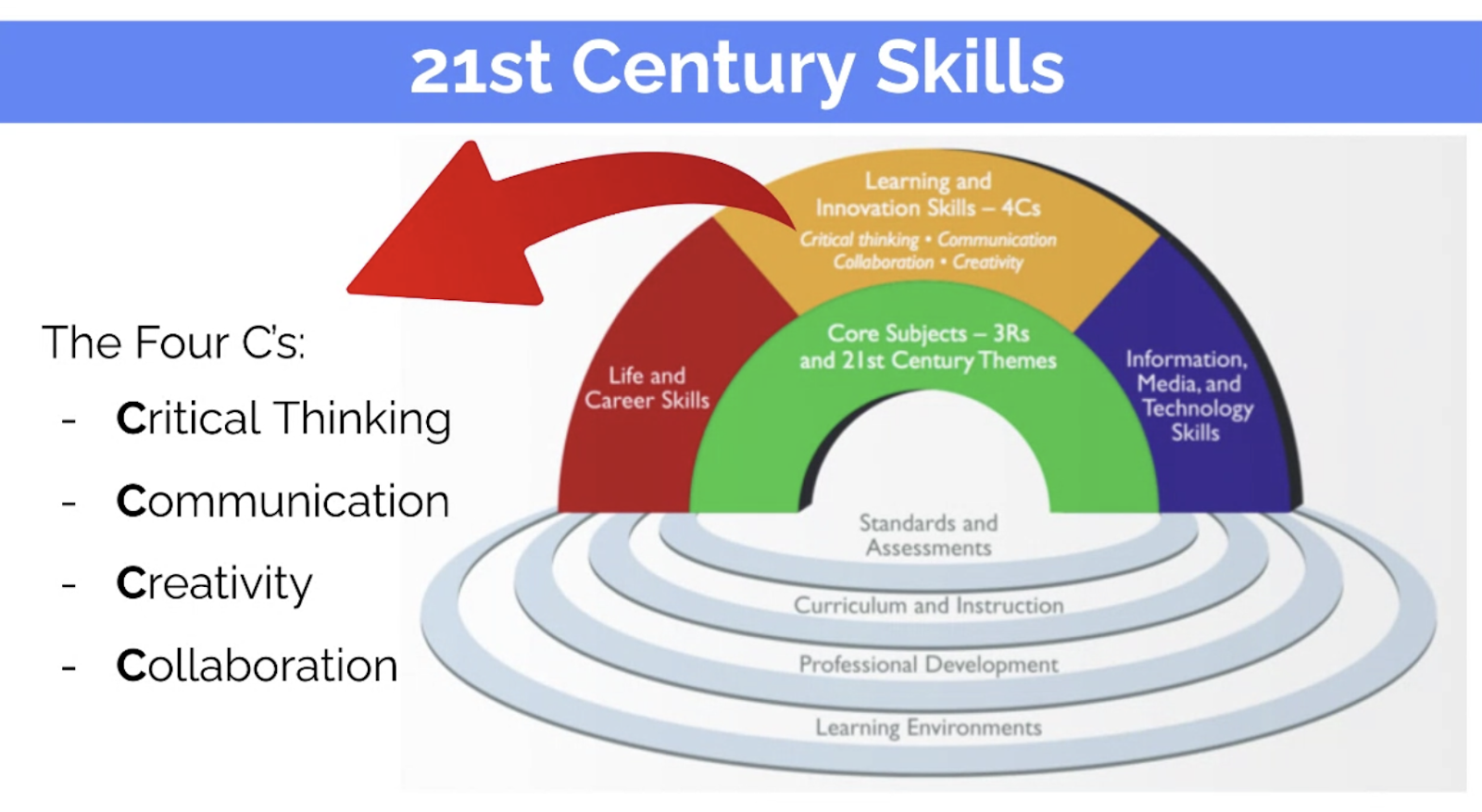

Critical thinking is one of, if not the most important element for our students to learn as they move into the real world - the ability to be discerning, and attentive to the content they are being bombarded with on a daily basis in the digital world. Moving beyond passively accepting the texts, and towards examining, evaluating, analysing, and critiquing the validity and credibility of what they are being presented with.


Thinking Frames 


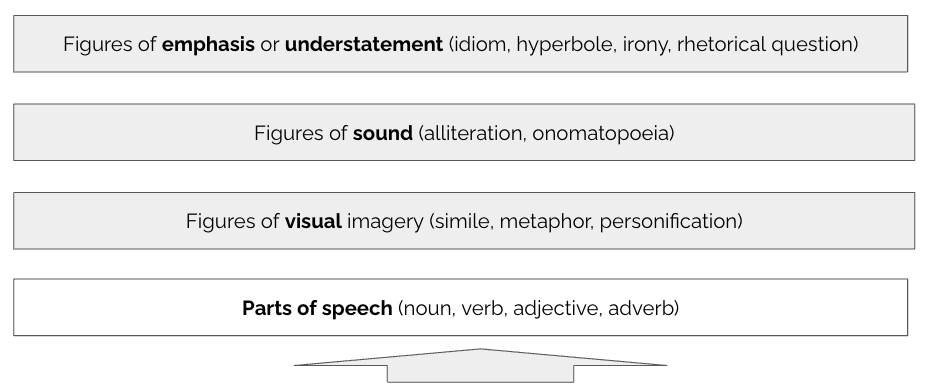
All of these concepts are based on the idea that as we think more deeply about the texts we read, our thought processes become more abstract, and require some synthesising, and analysing multiple pieces of information, both from the text, and prior knowledge, in order to make sense of the more complex ideas in the text.


Analysis: Deconstructing by looking closely at the parts (language features) of the texts (i.e character’s actions, authors purpose, structure of the text, PAILS)


An example of one of the ways I can implement this in my own practice is the use of digital tools to annotate and highlight key parts of a text that relate to the language features we are examining - we think about the idea of zooming in (looking at specific parts/phrases/words) or zooming out (making connections between separate parts of the text)


Learners need planned, ongoing opportunities to understand and appreciate how language features are used for effect within, and across texts.


I have often referred back to an acronym that we used a lot when I was studying to be a teacher; PAILS (purpose, audience, ideas, language, and structure), and when we teach students a text it is easy to focus on the ideas, and the language, however it is critically important for us to be aware, as teachers, that some of the other features are not always apparent to our learners (i.e how structuring a piece of writing can accentuate which ideas are most important, or how a seemingly simple narrative can have underlying ideas that are only present when we consider the purpose the author had for writing the text)


By examining the language and structure of a text we open our eyes to a wider world in which a text does not exist in isolation, but rather is a reflection of the author, and the world that we live in; taking into consideration the biases, and underlying influences that go into each text that we read.


Critical Literacy

“A critical literate person is able to examine the power relationships inherent in language use, to recognize that language is not neutral and to confront their own values in the production and reception of language” (Luke, 2012).


In order to get our learners thinking more critically it is important to provide them with provocations that generate conversation, and discussion. It is important while we do this to take into account that provocations can inspire emotional responses and reactions from the learners, and while this is important, it is also important for us to create a safe space where they can share their ideas, not entirely free from judgment, but where they can discuss/argue about the topic, or idea in the provocation without directing it at each other.


We were asked to use the text that we brought (No Girls Allowed SLJ3) in order to create a provocation for our learners to discuss; one that challenges a Critical Literacy theme (ageism,, cultural differences, gender bias etc.), and to create a “counter-narrative” writing activity that reframes the situation in our text to challenge the idea. I came up with the ones below;

Provocation: “Do girls need to be protected more than boys?”

Counter-NarrativeWrite an extra passage in the story; the organisers of the tournament are scared of how good Riley is, and want to find a way to stop her from playing and showing up the boys.


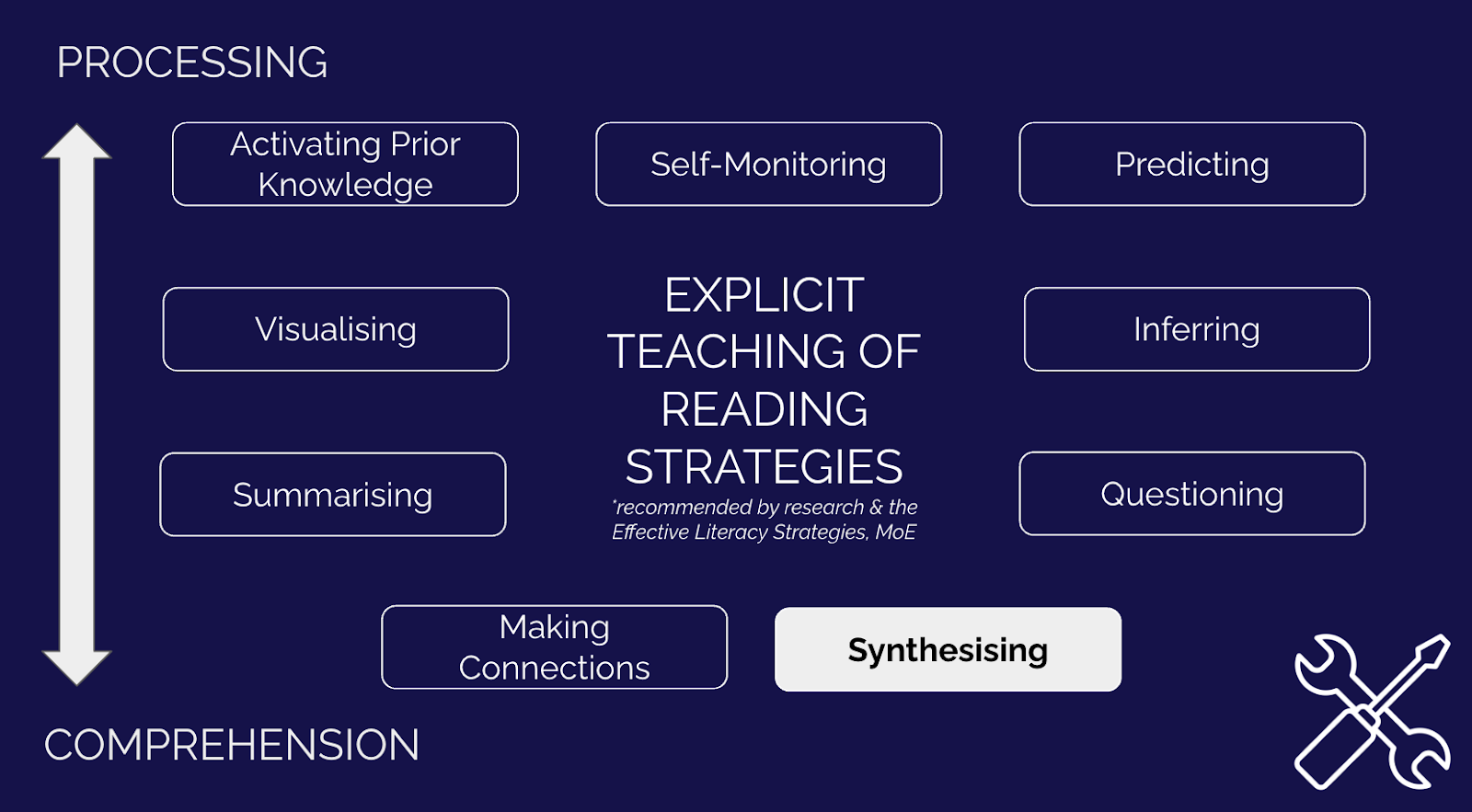
Sythesising

When taught how to synthesise through multi-text reading, readers come to understand the importance of weighing up information and perspectives from different sources (including their own). This is why it is important for us to use multiple texts which focus on a larger theme or idea. Nothing exists in isolation, and so our ability to draw on multiple sources of information allows us to form more well-reasoned, and well-rounded points of view on the idea.

In summary - this session has been probably the one with content most familiar to me; critical thinking, and information literacy is a throwback to a lot of what we taught as English teachers in secondary school. It is really interesting finding, and identifying some of the issues that we can discuss with our students at a primary level,  as far as Critical Literacy goes, are relevant to our students, and other which I had not considered useable at this age level.


This term we are focusing a lot on perspective - both the characters in the narrative, and the authors' purpose, and a lot of the content this week is going to challenge me to approach these texts in a variety of different ways.


Addendum:

I believe this level of analysis is of critical importance as young people these days are more and more influenced by the "texts" that they are exposed to, whether that be visual texts like TikTok videos or the ads that bombard them every couple of seconds while watching their favourite steamer, or the dialogue in video games they play. These are all texts that require us to examine and analyse them with a critical eye, and if we are ignorant of these things then we can easily be taken for fools.

Tuesday, 18 July 2023

MIT 2023 - Site went live!

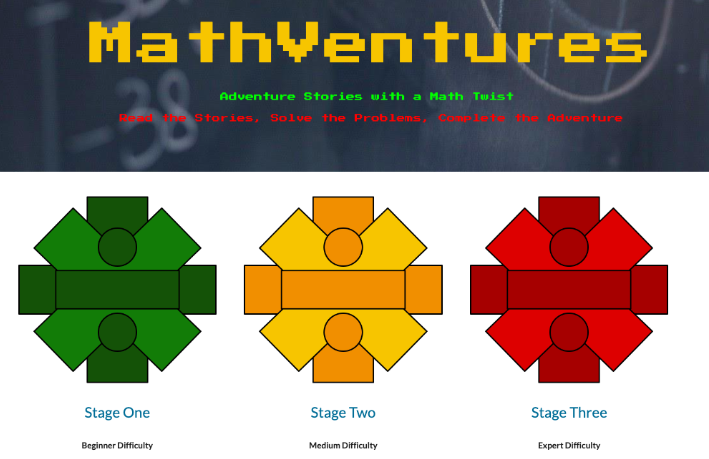
In the last block today the site went live, and I introduced it to Rooms 6,7,8 (all Year 6 classes) - there were some teething issues that arose like I needed to make sure that the site was not editable by everybody with the link - the students discovered this pretty quickly and a couple of them played around with the layout, so after a quick restore, and making sure all the new links were in place we started. A lot of the children chose to go for the easy MathVenture to start with, which I was not fussed about, I would like to see more of them go for the challenging texts, however, the tool is designed for self-selection, and students can progress through the difficulties at their own pace. 

One of the other issues that arose, that I was not able to diagnose on the spot was that some of the students found themselves unable to scroll down the page, while others were able to. I will have to figure out what was causing this issue and address it. 


The feedback from the students was overwhelmingly positive - they were excited to have more texts to take on, and I think what I will need is to find a time to regularly put out new ones - am thinking perhaps weekly, or fortnightly as I don’t want to over-promise and under deliver. I had a discussion with my team leader, who works with our lower-level literacy students, about the texts being more level-appropriate; she would like for the texts to be more readable, and perhaps shorter in length for the students at lower reading levels - we have students in our space who have reading ages of around 5-6 years of age, and even the easy texts were too long, and perhaps too difficult for them to make sense of and enjoy.


I will focus on the enjoyment element of it, as this is supposed to be engaging, and not a literacy-focused task - it is about unpacking the vocabulary. She also suggested that instead of having different word hyperlinks lead to the same page, and designed so that each hyperlink has a dedicated page of its own, for example, the “half” hyperlink leads to the same clarification as “share” rather than to a clarification of its own. She thought this would be a little confusing, I agree, however, I would also like for them to be able to see what other words can mean the same thing. Another comment was about having more images, and visual representation of the concepts to account for different learning styles. This will be time-consuming to set up, however, I can see real value in perhaps setting up separate clarification slides for each of the different difficulties, as the students taking on the easier challenges, and the students taking on the most difficult challenges are being linked to the same clarifications, some of which contain a great deal of writing on them. I still would like to limit each clarification to one slide per concept, as having to navigate through separate slides to find information can cause distractions and confusion, and take away from their flow as they move through the MathVenture. We have our MIT Online meets today, so perhaps I can use that to help with all of this.

Monday, 19 June 2023

Reading Practice Intensive - Session Six

 Session Six - Vocabulary


A robust vocabulary improves ALL areas of communication - listening, speaking, reading, and writing.

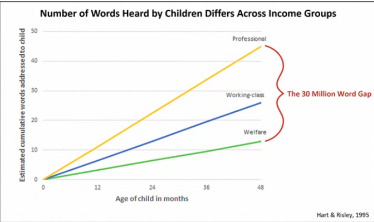
In our school community we need to be very interested in how we accelerate our learners because for a lot of our students they begin school with a huge deficit in terms of vocabulary, and language. Our kids listen to, and speak a far fewer words than the students from higher decile schools. 


We need to strengthen our use of word learning strategies to help our students build the lexicon needed to communicate their ideas in effective ways. 

Vocabulary knowledge accounts for 80% of the variance in reading comprehension, and is the strongest predictor of reading comprehension. Vocabulary is classically the way that we determine text difficulty.

One of the most overused, one dimensional ways of teaching words is to as students find definitions of words - so how do we move away from this?

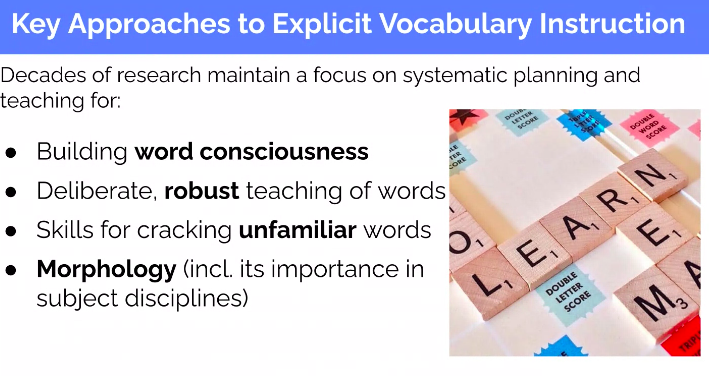
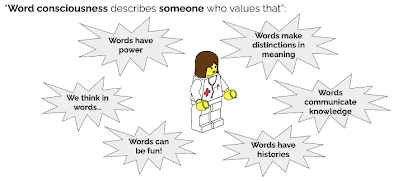
Helping students to build consciousness about the words that they use, and how the words they use are critical to creating specific and precise meaning that can help them to express their ideas more effectively. One of the ways we can do this is drawing attention to the words that we read by expressing interest and value in those words; this helps students to collect these words, so that they are able to use them in their responses, or in their writing.

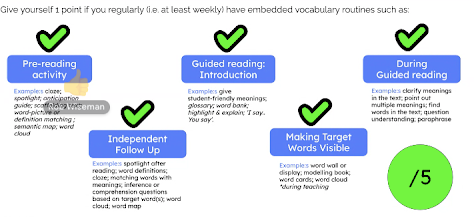
Word Consciousness is a critical part of learning and using new vocabulary, so how do we add it into our current practices of Robust Vocabulary teaching

Developing the use of Tier 2 words is critical for our students; remembering that we are trying to accelerate students in our school we need to identify specific areas of focus. Robust, interactive activities can be planned for; immediate transfer (response to text), delayed transfer (follow up) and Far transfer (maintaining, reviewing etc.)

Clarifying Meaning - How can we do it?

The ability to independently clarify texts is another skill that differentiates a struggling reader, from a proficient one.  One of my favourite strategies to focus on with students is Reciprocal Reading as it incorporates a variety of different comprehension strategies into an oral discussion (predicting, clarifying, questioning  and summarising)

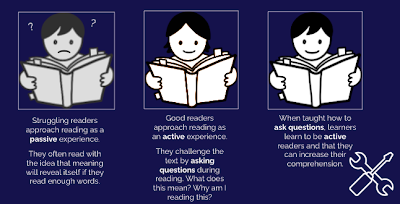
Let’s look at Questioning - Reading is an active process, and is not something that good readers do passively. Instead they ask questions while reading the text; what does this mean? Why have they used this word? What’s the difference between…? Why has the author said it this way?

This is an involved process for the students, and is something that they can gloss over if they are not well practised in this. For this reason it is important to scaffold this using different strategies (question cards, comprehension dice, reading buddy bookmarks), and to make sure that they take the time within the reading activity to stop, think, question, and process.

Morphology - the smallest unit of meaning.

The teaching of morphology is something that I have not looked at since I began my English degree - I had largely taken for granted a lot of the learning that I must have done early on in my own reading journey, in regards to how words are built, and how the different parts of the word help us to make meaning - these things I just took for granted until I came to teaching.

Part of my goal for the next 2 terms will be to more explicitly teach morphology, to help students understand how the different parts of the word make meaning, and that if we do not know a word, that this is a great place to begin with, particularly with my level of readers, who are moving into more and more complex texts with more use of jargon and subject specific vocabulary than ever before.

The Syntax Project has lessons and activities that I would love to incorporate into my own teaching practice - often what is done is we will work on breaking a word down together, either in group reading, or in shared reading, however it is something that I am yet to incorporate into my own lessons explicitly.

In summary, I am excited to apply this new learning to my classes; we are pushing to take on more, and more challenging texts, that may have confident readers second guessing themselves when they encounter lower frequency, and subject specific words which they have not familiarised themselves with. It is important that I don not take for granted their confidence as readers, and that respetition of strategies that they may have done in their younger years is not wasted because they can be updated, upgraded, and made to be more engaging for them if we look outside the traditional confines of vocabulary building through definition finding, and using the word in a sentence. These types of activities can be dull, and while they can be done independently, do not always translate to the students being able to use them on their own.


RPI Great Beginnings - Writing like Readers; Reading like Writers

 I am very lucky to work with such keen and interested kids. This week we have worked on writing for purpose, to explain, to entertain, to create suspense...

One of the activities that we have looked at as part of the RPI was a task where students were asked to rewrite an opening passage for a text using similar structure, vocabulary, and tone. 

This was the prompt we used;

We discussed the language features used, and how precise words were used to created precise meaning, and unpacked some of the unfamiliar vocabulary like loch, and shroud, as well as the onomatopoeia  and the similes that the author used. 

I didn't want to prompt them too much, aside from providing the scaffold that we used in RPI (see below)


This work was produced by Aliana, Cayden, Falen, and Maraea from Room 8 Literacy


Monday, 29 May 2023

Reading Practice Intensive - Session Five


Session Five has arrived in a hurry! It barely feels like a week since we were last together, but it's always a welcome  opportunity to take off my teaching hat, and to put my learning hat on.

Today we focused on Planning a Reading Program - thinking deliberately about all the little choices we make as teachers when we teach reading, not just what texts we are teaching, but to also consider how we deliver those texts to our students in a way which is engaging, interesting, but most importantly effective in getting our students to better understand what they are reading.

As teachers we it can sometimes be overwhelming trying to incorporate every thing that we know we should be doing into our lessons - if we had 35 hours in a day there would still be more to try and pack in there. So how do we manage this with only 4-6 hours with which to teach in a school day? The answer is a simple word. Planning.

It's a word I dreaded in my early years of teaching, and one that self-admittedly I still have a lot of room to improve on.

In this session we broke down what effective planning in a reading program looks like; for teachers, and for students planning removes a lot of the uncertainty, and anxiety around "what comes next?". Clear and effective planning means students, and the teacher can focus on the things that are really important;

1. Spending time with my students - coming from a high school teaching background I often have to remind myself that not everything can be done by students independently, and that a lot of the most valuable learning takes place in conferencing with students, prior to reading, and post reading. Prior to reading to help them draw connections between their own lives, and what we are learning about in the texts.

2. Making connections - nothing we learn, create or share exists within a vacuum. Giving students the opportunity to make connections, not just between the text, and their own lives, but to make cross-curricular connections too. Being able to integrate reading and writing into different subject areas means that we don't just read or write for the sake of mileage, we are using it as a tool for learning.

3. Teaching specific skills or strategies through explicit acts of teaching. Learning can happen through osmosis, but it is ineffectual in comparison to the explicit teaching of skills. Inference, for example, may be something that some students can do with ease, for others, it can be a mystery how people can figure things out, seemingly without clues. But the clues are there, and helping them to see those clues needs to be done deliberately.


 So, what did I learn from all this; well, first, I need to make deliberate plans to conference with my groups in order be more time-efficient. Conferencing with each group in my reading class is at least twice per week is going to be my goal to begin with, and limiting the time I spend with each group will also be managed more strictly. I am a blabbermouth, and if I am not careful, some of my carefully planned teaching can go out of the window because my students ask me an interesting question, and 40 minutes later we've managed to go down 4 or 5 different tangents.

What did I learn, that I can use with my learners? Well a lot, but there were two elements to todays learning that I took the most away from. 

First - utilising tools that are free, and readily available does not make me a lazy teacher. There are so many AWESOME resources out there, that are fun, and engaging for the students. Use them, and encourage the kids to use them outside of the classroom to foster a sense of accomplishment, pride, and self-efficacy in their ability to complete tasks independently.

Secondly was the Reading like a Writer, Writing like a Reader activity is something I am definitely going to borrow for my students. The task asks students to read the opening for a story, and to write their own story using style elements from the read text.


It is a wonderful way of exposing students to a much wider variety of text types that they may not have ever experimented with before. For students in my Year 6 class, this is incredibly important; they are being exposed to a wider range of texts than they have in their past years, and will be challenged to take on different styles of writing in the future. Preparing them for this means finding ways of supporting them and scaffolding them is critical.


Can't wait for the next session!


Saturday, 27 May 2023

MIT 2023 - KPMG Hui #2


Another early morning start, I tried asking my partner for a ride into the city to save myself a couple bucks, but her unintelligible groans gave me a pretty clear indication that I should find my own way in. 


I arrive early, and myself and Matt tap away on our laptops until the rest of the crew arrived. I think we'd both had a rough week of Fantasy so thought it best to leave that subject alone, and we trot over to the KPMG offices. A massive thank you, as always to Justine for hosting us so wonderfully, but for her helpful input, and advice. We begin our day reflecting on our project so far in the WWW session. This is such a great crew, and looking at their work, I am blown away at their creativity, and the innovative ideas they've come up with. I can't wait to see where we all end up. Sharing ideas in a setting like this has now become such an awesome experience, I feel privileged to be able to share ideas, and have them help me to craft and hone my own.


We presented our prototype testing - I was nervous for my testing, there were a lot of moving parts in my prototype design, from audio clips on Youtube, to response validations, with multiple questions, and large chunks of my own narrative writing (don't get me started on how nervous that part makes me) for my students to give me feedback on.  The testing started with a flop. My Youtube videos had not been properly categorized, and were unable to be viewed on our student's devices. Once that was sorted the testing was great fun to see, the kids were super encouraging, but I think that's more a reflection of how awesome they are, instead of how awesome the prototype was. 


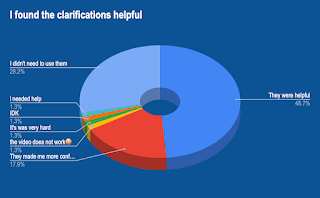
Each quiz ended with an opportunity for the kids to give me feedback, and I used that to help guide me in the process. For example; 49% of the students used the clarifications guide in the prototype, and a further 28% didn't need to use it. Other's found it confusing, and not useful. In further testing I will investigate how to make the clarification guide more useable.


Here are the results from the student feedback;


And here are my reflections on that round of testing


Tuesday, 23 May 2023

Manaiakalani Innovative Teachers - Project Update

As part of the Manaiakalani Innovative Teachers program this year we were asked to identify a problem that we felt was important to address in our classrooms. I identified a focus, and it was that I felt there were students in my class who had a really strong grasp on numeracy, but were limited in performing to the level that they were capable of because they were hindered by their literacy, particularly the comprehension of word problems in math tests like PAT.


The vocabulary can be tricky, the questions lack context, and let's be honest, the scenarios are somehow both weird, and boring. I don't want my kids thinking that math is boring, and I certainly don't want them thinking that reading is either.

My original thought was, unfortunately, deficit minded, and didn't focus on how I could reframe the problem towards building a solution. Alongside my fellow MIT colleagues we spent a wonderful weekend in Omaha breaking each others ideas down, and building them back up towards a forward thinking solution. If you would like to read more about this process check out this blog post about our Omaha Hui

As part of this process we developed a "How might we" statement to help us focus our intentions, and set our minds on the solution.

"How might we support students to unpack maths problems which contain unfamiliar language?"

I returned home inspired, and motivated to create - the first story entitled "Jacob's Village Life"  was trialed in the final week of term across a wide range of Year 5 & 6 students at Pt England School. The prototype was built using Google Forms - this allowed me to seperate the story into sections, to add images, and an accompanying audio track for students to follow along as they read, and hyperlinks to a set of clarification slides to help the unpack the operative words in the questions. See the example below.


At the end of the prototype story the students were asked to give feedback, and while it gave me some things to work on, the elements which were of highest importance to me functioned how I wanted them to - the clarifications helped close to 50% of the students, with close to 30% not needing them at all, and the students wanted more, and the text was interesting, and Forms was easy to navigate for our students. Further investigation into what made the Clarifications confusing for the 18% of students is needed, and is part of the next steps in the process.

I am currently in the process of adding texts to what will eventually be a library of texts with new releases, coming out regularly, covering a range of math, and reading levels to give access to as many students as possible, and extending the clarification slides to include a wider variety of vocabulary words, and math terminology. 


Follow along with this journey as our students explore, and hopefully, become great MathVenturers!

A Brand New Voyage!

  I start, and finish every year off with such a great sense of excitement; Christmas, New Years, and long, merry days in the sun wondering ...